What Is a Diesel Powered Generator and Where Is It Used?
A practical explanation of DG set parts, working cycle, kVA/kW sizing, industrial applications, and why diesel still leads the backup power market in India.
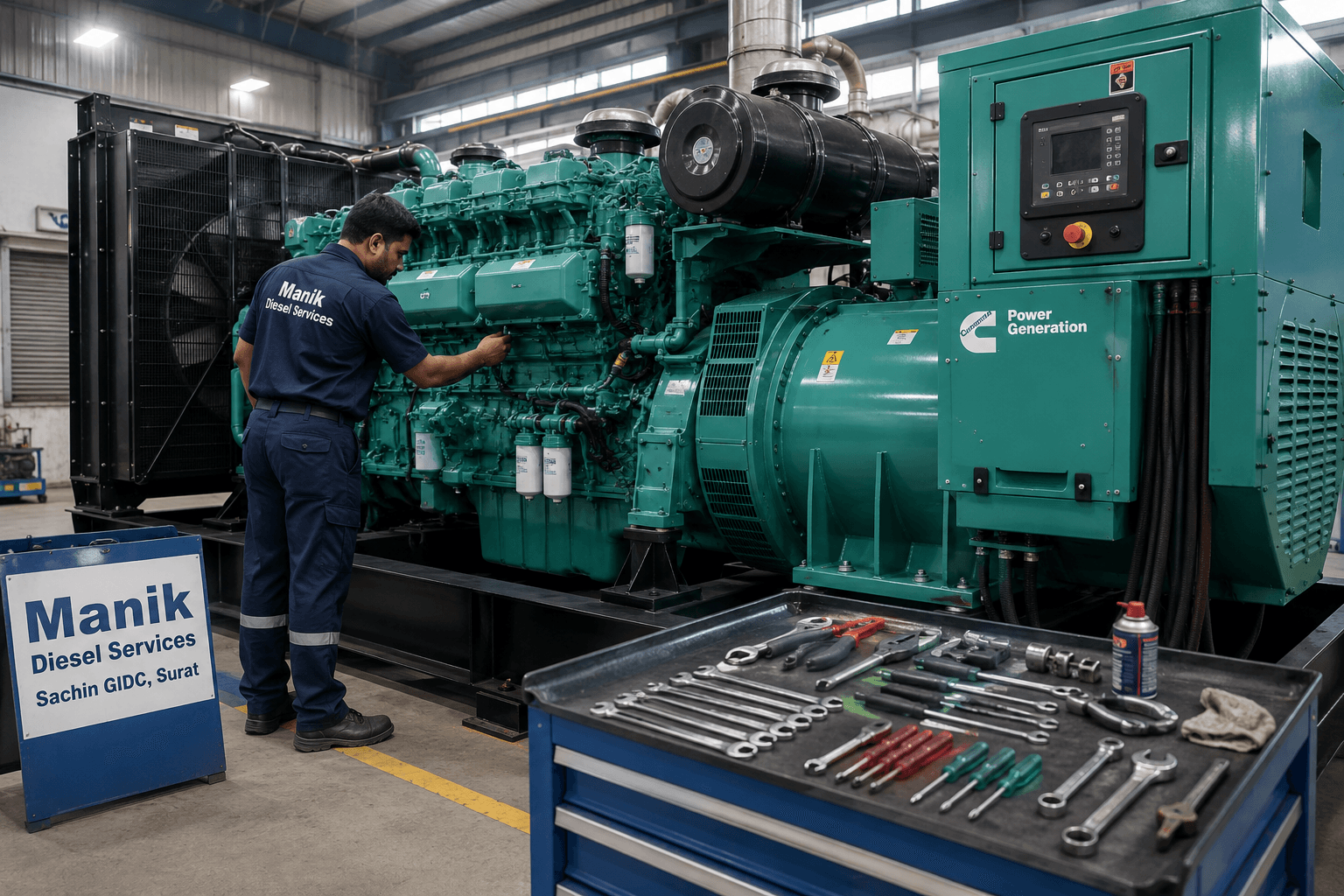
What a diesel generator actually is
A diesel generating set, or DG set, is one machine made of two coupled assemblies: a diesel engine that produces rotational mechanical energy, and an alternator that converts that rotation into electrical power. Both sit on a common bedframe, share a flywheel coupling, and are wrapped in a single set of support systems — fuel, cooling, lubrication, exhaust, control, and safety.
On industrial sites in South Gujarat, a DG set is rarely just a backup. For textile units in Pandesara, dyeing houses in Sachin GIDC, and chemical plants in Hazira, the generator picks up production load every time the grid dips, spikes, or fails. Over a year, many of these machines log more running hours than a small commercial truck.
The diesel engine — how the mechanical side works
A diesel engine creates power through compression ignition. Air is drawn into the cylinder, compressed to roughly 15 to 22 times its original volume, and fuel is sprayed into the hot compressed air at the exact moment of peak compression. The air temperature at that point — around 700 to 900 degrees Celsius — ignites the fuel without a spark plug. The resulting combustion drives the piston down, turning the crankshaft.
Most industrial DG engines run a four-stroke cycle: intake, compression, power, exhaust. The crankshaft connects to the alternator through a flexible coupling so that engine vibration is not transmitted directly into the generator end. Engine speed is held constant at 1,500 rpm for 50 Hz output (the Indian standard) by a governor that adjusts fuel rack position in real time as load changes.
Common industrial diesel engines for generator duty in India come from Cummins, Kirloskar, Mahindra Powerol, Ashok Leyland, Eicher, and Greaves. The mechanical fundamentals are the same across brands — the differences sit in fuel system design, governor type, cooling layout, and parts availability.
The alternator — how rotation becomes electricity
The alternator is a rotating-field synchronous machine. A direct-current excitation winding on the rotor creates a magnetic field. As the engine spins the rotor at 1,500 rpm, the field sweeps past stationary stator windings, inducing alternating current. The AVR — automatic voltage regulator — adjusts excitation current continuously to hold the output voltage steady across changing load.
Standard Indian three-phase generators output 415 V phase-to-phase, 50 Hz, with a neutral conductor for single-phase loads. The alternator is rated in kVA — apparent power — because real load includes both resistive (heaters, lighting) and inductive (motors, transformers) components. The ratio between real power in kW and apparent power in kVA is the power factor, typically 0.8 for industrial generator nameplates.
The support systems that decide reliability
An engine and alternator alone do not make a working DG set. The support systems are what determine whether the machine starts, runs, and survives at industrial duty cycles. Each system has predictable failure modes that show up first as performance loss and later as breakdowns.
The fuel system carries diesel from tank through primary filter, lift pump, secondary filter, into the fuel injection pump, and out through high-pressure lines to the injectors. Water contamination, blocked filters, and air leaks on the suction side are the most common faults. Our injector and FIP service covers this end of the system in detail at /services/fuel-injection-pump-repair.
The cooling system uses a radiator, water pump, thermostat, and engine-driven fan to remove combustion heat. Coolant level, hose condition, radiator cleanliness, and thermostat function decide whether the engine ever reaches operating temperature on cold mornings or trips on high temperature in summer afternoons. South Gujarat sites — particularly textile units with high ambient dust — need their radiators cleaned more often than the OEM service interval suggests.
The lubrication system circulates oil through the bearings, valve train, piston cooling jets, and turbocharger. Oil pressure protection cuts the engine if pressure drops below a safe threshold. Bypassing this protection is one of the fastest ways to destroy a crankshaft.
The exhaust system carries combustion gases away through a turbocharger (on most modern industrial engines) and out through a silencer. The control panel houses the AMF logic, instrumentation, alarms, and protections. Battery and starter motor handle cold cranking. A weakness in any one of these will produce a no-start, a no-load, or an in-service shutdown.
Where diesel generators are used in India
Diesel generators are deployed wherever a power interruption translates into lost output, lost data, or unsafe conditions. The list of applications is long but predictable: textile spinning and weaving mills, dyeing and printing units, chemical and pharma plants, hospitals, hotels and banquet halls, commercial complexes, schools and colleges, IT parks and data centres, telecom towers, construction sites, mining operations, oil and gas platforms, ports, railway signalling, and small-format manufacturing units.
Within South Gujarat, the heaviest concentration of industrial DG sets sits in the GIDC belts — Sachin, Pandesara, Hazira, Vapi, Ankleshwar, and the Olpad-Bardoli line. For many process plants in these areas, the DG set is not backup at all — it is the primary supply during peak summer demand restrictions or extended grid outages.
If you are planning industrial generator service or AMC in any of these areas, our service-area pages cover specific coverage and response times: /service-areas/sachin-gidc, /service-areas/pandesara, /service-areas/hazira.
Why diesel still leads despite gas and battery alternatives
Diesel generators face real competition from natural gas gensets, LPG sets, hybrid solar-battery systems, and grid-tied battery backup. Each alternative has a defined use case, but diesel still leads industrial backup power for three structural reasons.
Fuel storage is straightforward. A 1,000-litre diesel day tank gives a 250 kVA set around 18 to 24 hours of continuous runtime at 70% load. Natural gas requires either a piped supply (which fails when other utilities fail) or LPG bullet storage that adds installation cost and safety zoning. Diesel can be trucked to remote sites within hours.
Power density is high. A diesel engine produces more kW per kg and per cubic metre of installation footprint than any battery system at industrial scale. For a 500 kVA emergency requirement, a battery bank with equivalent runtime occupies far more floor area than the DG set, and the upfront capital cost is several times higher.
Repair and parts ecosystem is mature in India. Cummins, Kirloskar, Mahindra, Ashok Leyland, and others have decades of service network coverage. Spare parts, trained technicians, and OEM-equivalent components are available across major industrial belts. A diesel engine that goes down on Tuesday morning can typically be back in service Tuesday afternoon. A battery inverter fault often involves longer parts wait times.
How sizing starts — load, duty, environment
Sizing a DG set begins with an honest electrical load list: the actual running load that must be supported during an outage, broken down into resistive (heating, lighting, electronics) and inductive (motors, compressors, pumps) components. Motor starting current is often three to seven times running current, and this surge has to be supplied by the alternator without tripping or voltage collapse.
Once the load is established, the operating mode decides the rating: emergency standby (limited hours per year), prime (variable load, long hours, with grid as backup), or continuous (constant load, no grid). The same alternator iron and windings can be rated differently across these modes — a 250 kVA standby set is not a 250 kVA continuous set.
Environmental factors then derate the published rating. Altitude above 1,000 metres, ambient temperatures above 40 degrees Celsius, high humidity, and dusty conditions all reduce useful output. South Gujarat summer site conditions — 42 degrees ambient, 75% humidity, monsoon dust ingress — should be assumed in any sizing calculation done for the region.
Future expansion is the final factor. A site planning to add a new production line in eighteen months should not buy a generator sized exactly for current load. The replacement cost in that timeframe is greater than the cost of building margin into today's selection.
What goes wrong when a DG set is treated as just a backup
Many plant managers think of the DG set as a static asset — buy it once, start it occasionally, ignore it the rest of the time. This is how recoverable problems become major overhauls.
Diesel that sits in a tank for months absorbs water from condensation and grows microbial contamination. Batteries that are rarely cycled sulfate. Coolant that is never tested becomes acidic and starts attacking the head and water pump. Air filter elements that are unused still accumulate dust during routine ventilation. Belts crack from heat exposure even without being driven. By the time the grid fails and the DG set is finally asked to start, none of these systems have been confirmed ready.
A no-load test run every two weeks, a load test run every month, and a full AMC programme that catches consumables before they fail is the only way to ensure the set is actually available when needed. The cost of an AMC is dwarfed by the cost of a single failed start during a critical outage. We cover AMC structuring and pricing for South Gujarat sites at /services/dg-set-repair-amc.
Frequently asked questions
What is the difference between kW and kVA on a generator nameplate? kW is real power — the part of the output that does useful work. kVA is apparent power — the total electrical power including the reactive component. For most industrial diesel generators in India, the relationship is kW = kVA × 0.8, where 0.8 is the assumed power factor. When sizing for your actual load, work in kW for resistive loads and kVA for motor and inductive loads.
How long can a diesel generator run continuously without stopping? With adequate fuel supply, a properly maintained industrial DG set can run continuously for several hundred hours between service intervals. Long-run operation requires attention to oil top-up, coolant level, fuel filter changes on schedule, and load profile within the prime or continuous rating.
Are diesel generators allowed in cities with emissions restrictions? Newer industrial DG sets sold in India comply with CPCB-IV+ emission norms. Older sets in service are subject to local pollution control board rules — many sites must either retrofit emission controls or replace sets that are below current norms. Always check the prevailing CPCB and SPCB notifications for your site location before installation.
Can a diesel generator power my home? Domestic backup is possible but uncommon — small portable gasoline or inverter-battery systems are more practical for typical home loads below 5 kVA. Diesel becomes the better choice above 10 kVA when continuous runtime, fuel cost per unit, and durability matter more than purchase price.
How often does a DG set need service? At minimum, four scheduled visits per year for a set on standby duty with limited running hours. For industrial sets running daily, intervals follow running hours: oil and filter every 250 to 500 hours, fuel filter every 500 hours, coolant check at every visit, full load test annually. Specific intervals depend on OEM specification and site conditions.
Talk to Manik Diesel Services about your DG set requirement
Manik Diesel Services has been working on diesel engines and DG sets from our Sachin GIDC workshop in Surat since 1981. We started with Cummins engine service and have grown to cover all major Indian and imported diesel brands across fuel injection, overhauling, AMC, and breakdown attendance.
If you are evaluating a new DG set purchase, an AMC for an existing set, or trying to diagnose a recurring fault, contact us on +91 99980 20245. Workshop hours are Monday to Saturday, 9 AM to 7 PM. You can also reach us on WhatsApp at wa.me/919998020245 to describe your engine make and the issue you are facing — we will tell you whether it can be handled on site or needs to come in.