Fuel Injection Pump Failure: 7 Warning Signs Your FIP Needs Bench Calibration Now
Seven real failure signs that tell you a DG set FIP needs bench calibration — before black smoke, misfires, or hard starts turn into a full breakdown.
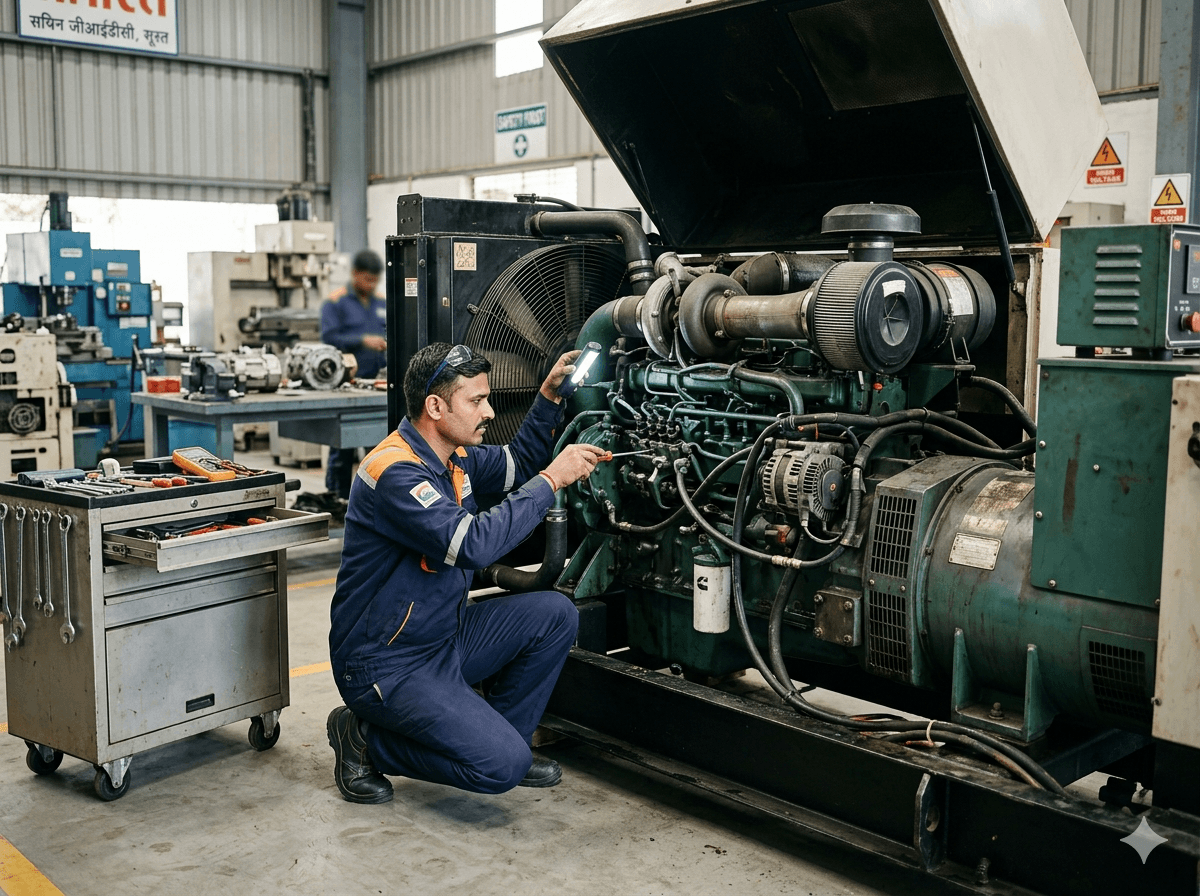
Why DG set FIP failure reads differently than automotive
Most online material about fuel injection pump failure is written around truck and tractor engines. DG set FIPs run differently: constant speed at 1500 RPM, steady load cycles, and calibration tolerances set for a specific kVA output. When something goes wrong, the symptoms follow a different pattern than a variable-speed vehicle engine.
The seven signs below come from work done on our FIP test bench at Sachin GIDC, Surat. We see these failure patterns regularly across generators from 15 kVA to 500 kVA — Kirloskar, Cummins, Mahindra, Perkins, and Ashok Leyland engines among others. If your set is showing more than one of these signs at the same time, do not wait for the next scheduled service.
Warning sign 1: Black smoke that was not there before
A healthy diesel engine under load produces faint grey exhaust. Dense black smoke under the same load as last month points directly at a fuel-air ratio problem — typically too much fuel relative to the air entering the engine.
At the FIP level, this is usually a delivery valve that is not seating cleanly, a worn plunger helix that no longer cuts off fuel delivery sharply, or calibration drift that has pushed delivery volume above the specified cc per stroke. Left unaddressed, the excess fuel wets the cylinder walls, degrades lubrication, increases liner wear, and fouls injector nozzles faster than normal. You also carry higher fuel cost for the same kW output.
Warning sign 2: Noticeable power loss under load
If your set handled a 200 kVA load last year and now the frequency drops noticeably when the same load connects, the engine is not producing what it should. Before you assume engine wear, check the FIP.
Plunger wear reduces the effective stroke that pushes fuel to the injectors. As the plunger-barrel clearance widens with hours, fuel leaks back past the plunger instead of going forward to the injector. Each element delivers slightly less than its calibrated volume. The engine cannot produce rated torque, frequency droop increases under load, and the AVR has to work harder to maintain voltage. On a bench, we can measure element-by-element delivery and identify which elements are worn below tolerance.
Warning sign 3: Hard starting after a normal shutdown
A DG set that cranks for more than a few seconds before firing — when it used to start reliably — often has a FIP that is losing its residual pressure between starts.
Delivery valves hold a small positive pressure in the fuel lines after shutdown. This residual pressure allows the injectors to open quickly on the first compression stroke. When delivery valves wear or the seating face corrodes, that pressure bleeds back into the pump. On the next start, the engine has to pump up pressure from near zero, which means more cranking cycles, more battery drain, and harder work for the starter motor. In humid coastal conditions around Surat, delivery valve seats corrode faster than in drier climates, so this failure mode is more common here than the service manuals suggest.
Warning sign 4: Fuel consumption spike with no load change
Track your diesel consumption per running hour. If that number has climbed by 10 percent or more without a change in connected load, the FIP is a primary suspect.
Over-delivery from calibration drift burns excess fuel. The engine produces the same output as before, but the pump is sending more fuel per stroke than the specification requires. This is invisible from outside the engine — there may be no smoke, no power loss, nothing obvious. The only early signal is the fuel log. On a test bench, we can re-calibrate delivery to specification and typically recover a significant part of the excess consumption. Operators who run DG sets on long shifts — textile factories, chemical plants, continuous process lines — recover the bench calibration cost in saved fuel within weeks.
Warning sign 5: Governor hunting and surging speed
The governor controls FIP rack position to maintain 1500 RPM under varying load. When you hear the engine speed rise and fall in a slow cycle — typically 0.5 to 2 Hz — without any load change, the governor mechanism inside or connected to the FIP is hunting.
Governor hunting can come from worn flyweights that no longer respond smoothly, a sticky rack that catches and releases instead of moving freely, or a control spring that has lost tension. Each oscillation drives a voltage and frequency swing at the panel. Sensitive equipment — UPS systems, CNC machines, server rooms, process controls — cannot tolerate sustained frequency cycling. Continued hunting also accelerates wear across the entire governor mechanism. A bench inspection lets us isolate whether the fault is in the pump governor, the linkage, or the speed-droop setting.
Warning sign 6: Uneven cylinder firing and rough running
A multi-cylinder diesel running smoothly has a consistent firing interval and a steady exhaust note. Rough running — irregular combustion sound, vibration that was not there before, or an exhaust note that sounds like one or two cylinders are misfiring — often points to uneven fuel delivery across the pump elements.
Each element in an inline FIP is supposed to deliver the same quantity of fuel at the same injection timing. When one element is worn more than the others, or when a delivery valve on one element is faulty, that cylinder fires differently from the rest. The unevenness is mechanical, not electrical, and it gets worse as load increases. On a test bench with a calibration stand, we measure delivery from every element at multiple rack positions and correct the variation. This is not something that can be diagnosed accurately without bench equipment.
Warning sign 7: Rising exhaust gas temperature
EGT sensors or pyrometers on industrial DG sets tell you how hard the engine is working. A rising EGT trend at the same load as previous readings, or EGT consistently above the manufacturer's limit, points to combustion that is running hotter than it should.
Late injection timing is a common cause. As the FIP timing mechanism wears, injection can retard — fuel enters the cylinder later in the compression stroke, combustion extends into the expansion stroke, and more heat goes out through the exhaust than gets converted to work. The result is high EGT, reduced efficiency, and faster turbocharger wear because it is running hotter gas. Timing drift is correctable on a test bench by checking and adjusting the spill timing, but it requires the pump to be removed and set up correctly.
What bench calibration actually involves
When a FIP arrives at our workshop for bench calibration, we start by flushing the pump with clean calibration fluid and running it on the test bench at operating speed to check current delivery figures before any adjustment. This baseline measurement tells us exactly what the pump is doing versus what it should do.
From there, we work through element delivery balance, delivery valve condition, governor response, timing, and maximum fuel stop. We use manufacturer specification sheets for the engine and pump model. After adjustments, we re-run the pump to confirm that delivery is within tolerance across the full rack travel range. The report we return with the pump shows before and after figures for every element. If you need FIP bench calibration or want a pre-failure inspection done, you can see what we cover at our fuel injection pump repair service page at /services/fuel-injection-pump-repair.
Frequently asked questions about FIP failure in DG sets
How often should a DG set FIP be sent for bench calibration? For a set running 8 to 12 hours per day in an industrial environment, we typically recommend a bench inspection every 3000 to 4000 running hours or every two years, whichever comes first. Sets that run on poor-quality diesel, show any of the seven warning signs above, or are used for critical applications should be inspected sooner.
Can I run the set until the next scheduled service if I see one of these signs? That depends on the sign. Governor hunting and rising EGT need prompt attention because they can damage other components quickly. Black smoke and hard starting can sometimes wait a few weeks if the set is not critical, but every day of delay increases the wear that the bench technician has to correct. Power loss and fuel consumption spikes can usually be scheduled at the next convenient shutdown window.
Does bench calibration fix all FIP problems? Calibration corrects delivery volume, balance, governor settings, and timing. If the plungers or barrels are worn beyond serviceable limits, those elements need replacement. We check wear during the inspection and advise on what can be recalibrated versus what needs new components before agreeing on the scope of work.
How long does bench calibration take? A standard inline pump calibration typically takes one working day once the pump is at our workshop. If component replacement is needed, add time for parts sourcing. We work Monday to Saturday, 9 AM to 7 PM, and can usually give you a turnaround estimate when we receive the pump.
What information should I give when I bring in a FIP? Engine make, model, kVA rating, and the pump part number or engine serial number help us pull the correct specification sheet before the pump arrives. A brief description of the symptoms you have observed — when they started, how the set is loaded, and current running hours — helps us prioritize what to check first on the bench.
Send us the details on WhatsApp
If your DG set is showing any of the signs described above, send the engine make, kVA rating, and a brief description of what you are observing to +91 99980 20245 on WhatsApp. A technician will respond with a practical next step — whether that is a bench inspection, an on-site check first, or a scheduled service visit.
We are at Sachin GIDC, Surat, and serve industrial sites across South Gujarat. Workshop hours are Monday to Saturday, 9 AM to 7 PM.