How to Choose the Right Diesel Generator Size for Your Industrial Site
A buyer's guide for plant managers: load calculation, starting current, duty cycle, derating, brand selection, and AMC planning before the purchase order is signed.
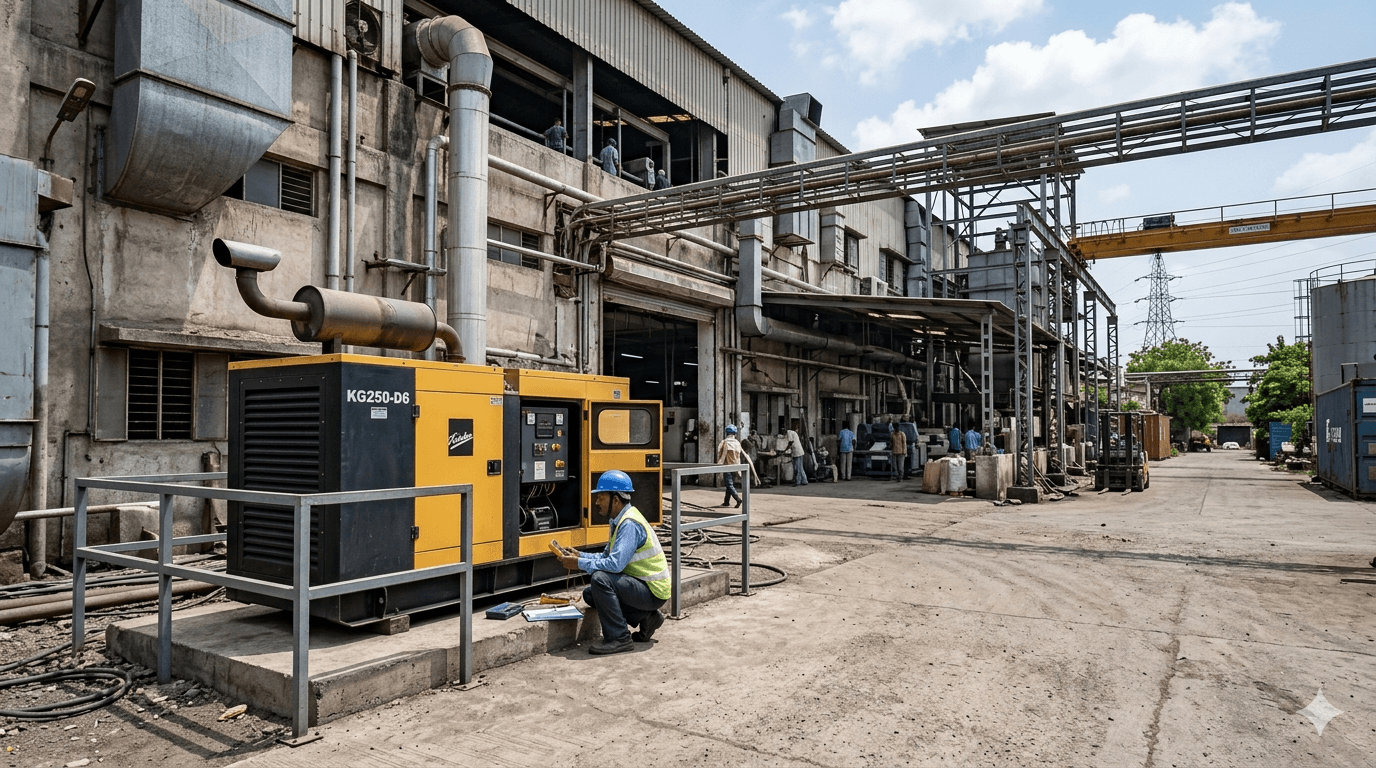
Sizing mistakes cost more than the generator does
A wrong DG set is expensive twice. The first cost is the purchase. The second — and usually larger — is the operating, repair, and replacement bill that follows for the next ten to fifteen years. Most plant managers underestimate how much a sizing error compounds across that time horizon.
Undersized sets trip during motor starts, overheat under sustained load, and shorten the life of the alternator windings. Oversized sets run lightly loaded most of the time, accumulate carbon deposits from incomplete combustion, glaze cylinder bores, and consume more fuel per useful kWh than a correctly sized machine. Both errors are common in South Gujarat industrial procurement, and both are avoidable with a structured sizing process.
This guide is the same one we walk procurement teams through when they bring us a load list and ask for a recommendation. It applies to standard industrial applications between 50 kVA and 1,250 kVA — the band where most textile, dyeing, chemical, and process plant installations sit.
Start with the actual running load, not the nameplate total
The first sizing input is a load list. Walk through the plant with the electrical drawings and list every load that must run during a grid outage, with its rated kW or kVA, its expected duty cycle, and whether it is resistive or inductive. Lighting, fans, computers, instrumentation, and resistive heating are resistive. Motors, pumps, compressors, lifts, and welding sets are inductive and bring starting surges with them.
The mistake at this stage is to sum every nameplate rating across the plant. Most plants do not run every machine simultaneously. A textile unit with twenty looms may only need fifteen running during an outage if the changeover shift overlaps. A chemical batch plant may have ten reactors but only three running at a time. Identify what actually runs concurrently, not what could theoretically run.
Once the simultaneous-run list is built, separate essential from non-essential. Office air conditioning may be non-essential during a short outage. Cold storage compressors and inert gas blanket pumps are essential and cannot be shed. The essential load is the basis for the standby generator rating. Non-essential loads can be brought back through a phased load acceptance once the set is stable.
Starting current is what trips your set, not running current
Induction motors draw three to seven times their running current during the first few seconds of startup. A 30 kW motor running at 60 A may pull 240 A or more during direct-on-line start. If your generator alternator cannot deliver that surge without voltage collapse, the motor will not start cleanly — and on a multi-motor site, every subsequent start makes the problem worse.
There are three ways to manage starting load. First, oversize the alternator to handle the largest single motor start while other loads are present. Second, use soft starters or variable frequency drives on the largest motors to reduce the inrush. Third, sequence the starts so the generator never sees more than one large surge at a time.
For procurement, the practical question is: what is the largest motor on the essential load list, and what is its starting method? A site with a single 75 kW compressor on direct-on-line start needs a larger generator than a site with the same compressor on a soft starter. Document this for every motor above 15 kW before finalising the alternator rating.
Choose the duty rating that matches how the set will actually be used
Generator manufacturers publish three different ratings on the same machine: emergency standby (ESP), prime (PRP), and continuous (COP). These are not marketing terms — they correspond to ISO 8528-1 definitions and they decide how long the engine can run, how much load it can take, and how the warranty applies.
Emergency standby is for limited running hours per year (typically under 200) at variable load up to 100% of rating, with no overload capability. It is the appropriate rating for sites with reliable grid power that only need backup during occasional outages.
Prime power applies to unlimited running hours per year at variable load averaging 70% of rating, with 10% overload available for one hour in twelve. This is the right rating for most industrial sites in South Gujarat that lose grid power weekly and rely on the DG set as a regular alternative supply.
Continuous power is for unlimited hours at constant load up to 100% of rating, with no overload. This applies to sites with no grid connection — quarries, remote process plants, and some construction operations.
Choose the rating honestly. Buying a standby-rated set and running it on prime duty will void the warranty and shorten engine life. Buying a continuous-rated set for occasional backup duty pays for capability you will never use.
Derate for site conditions before locking the size
OEM ratings are published at reference conditions: typically 25 degrees Celsius ambient, 100 metres altitude, 30% relative humidity. South Gujarat industrial sites rarely match this. Summer afternoon ambient in Sachin, Pandesara, or Hazira regularly exceeds 40 degrees. Monsoon humidity sits above 75% for weeks. Coastal sites near Hazira have salt-laden air.
Standard derating rules for industrial diesel generators in Indian conditions: roughly 4% reduction per 10 degrees Celsius above 25 degrees ambient, roughly 1% per 100 metres altitude above sea level, and additional consideration for humidity at the higher end. A 250 kVA nameplate set running at 42 degrees ambient in Surat delivers closer to 230 kVA of useful capacity. This is not a defect — it is normal physics, and procurement specifications should account for it.
The right way to use derating is to specify the net required output at site conditions, then ask the supplier to nominate a nameplate rating that meets that net requirement after derating. Do not let the supplier quote at reference conditions when the equipment will operate at 42 degrees and 75% humidity.
Brand selection — what each major Indian OEM brings
The Indian industrial DG market is dominated by a handful of OEMs, each with distinct strengths. The choice matters less for headline performance and more for parts availability, technician familiarity, and total cost of ownership over the engine's life.
Cummins is widely deployed across India with broad parts availability, strong service network, and engineering documentation in English. Cummins engines are robust under heavy duty and have predictable maintenance schedules. Initial purchase cost is on the higher end of the market.
Kirloskar is the dominant Indian-origin brand for industrial generators. Strengths include cost-effective spare parts, deep service network in tier-2 and tier-3 cities, and engines tuned for Indian fuel quality variation. Kirloskar Green is particularly common in textile and process plants in South Gujarat.
Mahindra Powerol delivers competitive pricing on light to medium industrial sets, and has expanded coverage on AMF panels and integration features. Strong dealer network in agricultural and small-industrial belts.
Ashok Leyland and Eicher serve the lower end of the industrial market with cost-competitive engines that suit standby duty for commercial buildings, smaller factories, and hospitality. Greaves and Mitsubishi (assembled in India) cover specific niches.
We have written a separate comparison covering Cummins versus Kirloskar in detail at /blog/cummins-vs-kirloskar-dg-set, which goes into specific applications, parts cost, and AMC structuring for each.
Plan installation before you finalise the order
Installation requirements are not afterthoughts — they directly affect the equipment specification and the project timeline. Settle these questions before the purchase order is raised.
Foundation and floor loading. A 500 kVA set with canopy weighs around 4 to 5 tonnes; foundation design must match. Ventilation. Industrial DG sets need substantial intake and exhaust air for cooling and combustion — typically a cross-section of 1 to 2 square metres for medium sets. A poorly ventilated DG room becomes a furnace in summer and the set will derate further.
Exhaust routing. Discharge height, distance from intake openings, and direction relative to neighbouring buildings all matter for both performance and CPCB compliance. Fuel storage. Day tank capacity should support at least 8 hours of full-load runtime; bulk storage above that needs separate fire safety design. Cable routing and switchgear. The synchronising panel, change-over switch, and outgoing feeders need to be specified alongside the set.
Acoustic enclosure rating. CPCB norms specify 75 dB(A) at one metre for industrial silent canopies. Site location and neighbouring noise-sensitive premises may require lower noise levels and additional acoustic treatment of the room.
Plan AMC and parts availability from day one
A DG set without a maintenance plan is an asset waiting to fail. Buying decisions should include the AMC structure for the first year, the expected spare parts cost over five years, and the response time guarantee from the service provider.
South Gujarat sites should look at AMC scope, not just AMC price. A low-priced AMC that excludes consumables, excludes labour for major repairs, and offers a 24-hour response time will cost more in unplanned downtime than a properly structured AMC at higher annual fee. Our /blog/dg-set-amc-vs-pay-per-visit post breaks down the economics in detail.
Parts availability in the local market also matters. Cummins and Kirloskar parts are routinely available in Surat. Some less common brands — particularly imported engines that have not been assembled locally — may have longer lead times for filters, gaskets, or electrical components. Confirm parts strategy with the supplier before purchase.
We provide AMC and breakdown service from our Sachin GIDC workshop covering the full South Gujarat industrial belt. Details at /services/dg-set-repair-amc.
How to read a supplier quotation critically
Supplier quotations vary considerably in what they include and exclude. A lower quoted price often hides costs that surface during installation or first-year service. Read every quote with these questions in mind.
Is the rating quoted at site conditions or reference conditions? Are commissioning, load testing, and CPCB compliance certification included? Is the AMF panel of the specified make and feature set, or a generic substitute? Are first fill of oil, coolant, and diesel included? What is the warranty duration and what does it cover — engine only, or full system?
Are the first three to five service visits included? What is the spare parts price list for filters, belts, hoses, and consumables? What is the response time guarantee for breakdown attendance? Is the canopy compliant with CPCB noise norms at site? Is the foundation, electrical termination, and exhaust routing in the supplier's scope or yours?
Compare quotes line-by-line on these terms before comparing on price. A clear scope-aligned comparison usually shifts the apparent ranking of suppliers.
Frequently asked questions
How much margin should I add for future expansion? A reasonable working rule is 15% to 20% margin above the calculated essential running load, plus headroom for the largest motor starting surge. Beyond that, plan to add a parallel synchronised set rather than oversize a single machine — paralleling is more efficient as load grows and gives you redundancy at the same time.
Is a silent canopy necessary or can I install in an open room? An acoustic enclosure (silent canopy) is mandatory for CPCB compliance on outdoor installations. For indoor installations in a dedicated DG room, an open set is acceptable provided the room itself is acoustically treated. The choice often comes down to whether you have a suitable indoor location and whether the room ventilation can be engineered correctly.
Should I buy new or refurbished? New sets carry full OEM warranty, current emission norm compliance, and predictable lifecycle. Refurbished sets save 30% to 50% on initial cost but bring uncertainty on remaining life, possible non-compliance with current emission norms, and limited warranty. For continuous industrial duty, new is usually the right choice. For short-duration standby duty on a budget, a properly inspected refurbished set can be acceptable.
How long does delivery take after I place the order? For standard 100 to 500 kVA industrial sets from major Indian OEMs, lead times typically run 6 to 10 weeks. Customised configurations, paralleled sets, or imported components extend this. Plan the procurement timeline against your installation window — do not commit to a go-live date before confirming lead time in writing.
Can I size a generator only on running load and ignore starting current? No. Many sizing failures originate exactly this way. Even if the total running load is well within the generator rating, a single large motor start can collapse the bus voltage and trip the set. Always confirm the largest motor's starting current and its starting method as part of the sizing calculation.
Talk to us before you buy
Sizing and supplier selection are decisions you live with for the next decade. At Manik Diesel Services we have been servicing diesel engines and DG sets in Surat since 1981. We can walk through your load list, recommend a rating range, identify the right brand match for your duty profile, and help you read supplier quotes critically — before you sign the purchase order.
Contact us on +91 99980 20245 or via WhatsApp at wa.me/919998020245. Workshop hours are Monday to Saturday, 9 AM to 7 PM. For ongoing service and AMC after purchase, see /services/dg-set-repair-amc.