Diesel Engine Overhaul: When to Overhaul and What It Costs in India
How to decide when a diesel engine needs an overhaul versus a targeted repair — compression test, running hours, oil consumption, and overhaul cost ranges for industrial DG sets.
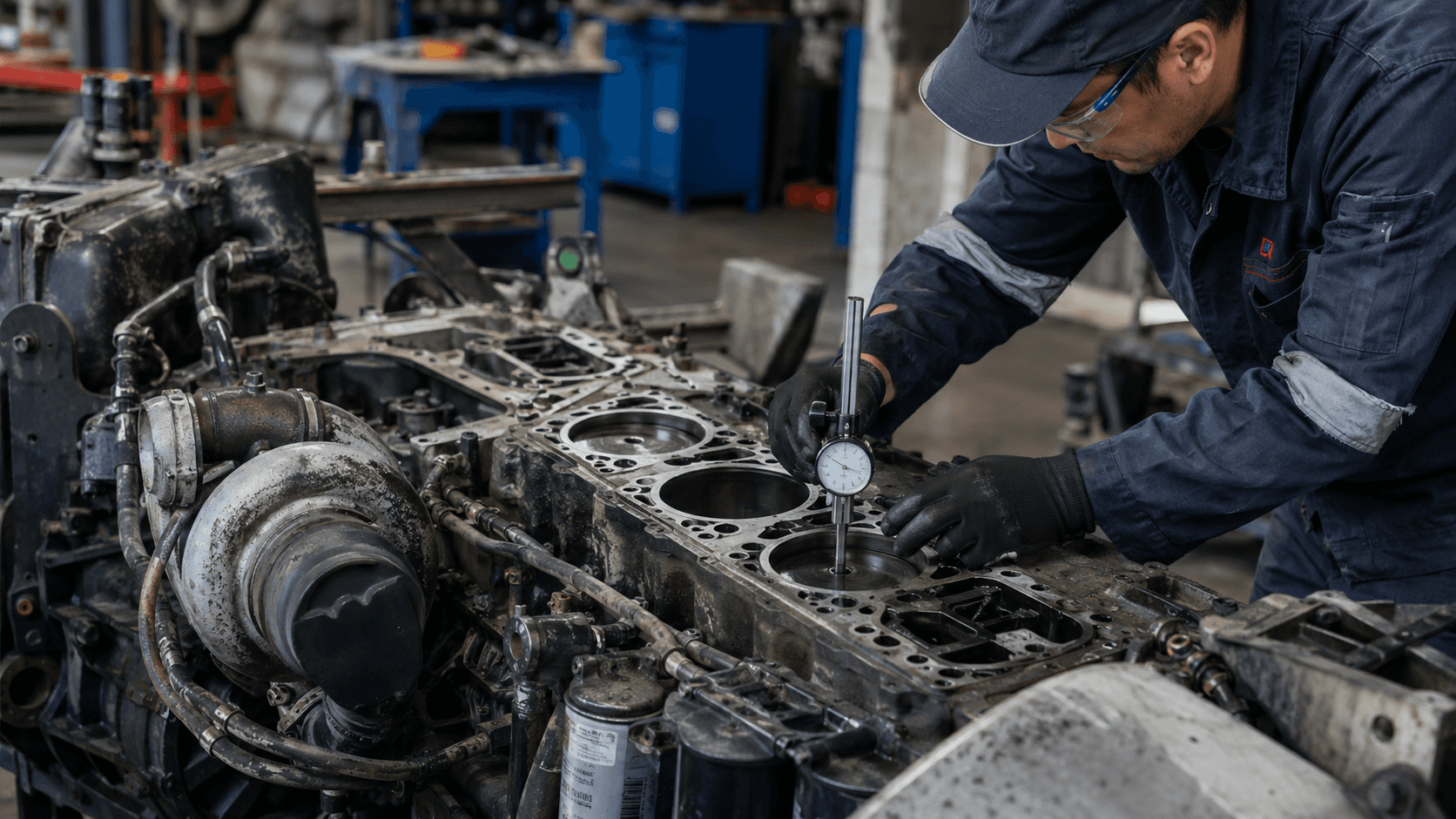
The decision that most plant managers put off too long
An engine overhaul decision is expensive whichever way it goes. Overhauling too early wastes money on an engine that had more life. Overhauling too late — or not overhauling when the engine is clearly past its limits — means paying for a series of targeted repairs that collectively cost more than the overhaul would have, while accepting degraded performance throughout.
The difficulty is that there is no dashboard warning light for 'overhaul now'. The decision requires reading several signals together: compression test results, oil consumption rate, smoke behaviour, power output under load, hour meter, and maintenance history. This article walks through each signal and gives the thresholds that indicate when an overhaul becomes the correct call for industrial diesel engines in the 100 kVA to 500 kVA range.
What an overhaul actually involves
A diesel engine overhaul — also called a top overhaul or major overhaul depending on scope — is a systematic strip-down, inspection, and rebuild of the engine's core components. The scope varies by condition but typically includes new or re-ringed pistons, cylinder liner inspection and possible rebore or replacement, new piston rings, bearing measurement and replacement, valve grinding and seat reconditioning, cylinder head decarbonising, oil pump clearance check, and seal and gasket replacement throughout.
A top overhaul covers the cylinder head and upper cylinder assembly — valves, seats, guides, springs, head gasket, pistons, and rings — without fully stripping the crankshaft assembly. A major (full) overhaul includes the crankshaft bearings, connecting rod bearings, camshaft bearings, and timing components in addition to everything in the top overhaul.
The scope is determined by what the initial inspection and measurements reveal. We do not quote an overhaul scope until the engine has been stripped, measured, and the findings documented. A plant manager who is told 'the engine needs an overhaul' without measurements to back it up should ask for the compression test results and the specific measurement findings that support the recommendation.
Compression test — the primary overhaul indicator
A compression test measures the pressure achieved at the top of the compression stroke in each cylinder with the injectors removed and the engine cranked by the starter. It is the most objective single indicator of ring, liner, and valve seal condition.
For a typical industrial four-stroke diesel in the 100 to 500 kVA range, new-engine compression values sit between 28 and 35 bar depending on engine make, compression ratio, and altitude. The OEM service manual specifies the new-engine value and the minimum acceptable limit.
Two threshold signals indicate an overhaul is warranted. First, absolute value: when any cylinder falls below the OEM minimum — typically 60% to 70% of new-engine spec, or around 18 to 24 bar — that cylinder is not sealing adequately. Second, variation: a difference greater than 10% to 15% between the highest and lowest cylinder readings in the same engine indicates uneven wear. Even if all cylinders are technically above the minimum, high variation causes rough running, injector imbalance, and progressive loading on the better cylinders.
A wet compression test — where a small amount of engine oil is introduced to the cylinder before testing — helps diagnose whether low readings are from ring/liner wear or valve seal failure. If the reading improves significantly with oil, the ring and liner are the source. If the reading stays low despite oil, the valves are sealing poorly.
Oil consumption — the second key indicator
Every diesel engine consumes some oil — it is a design feature, not a fault. Normal oil consumption for a healthy industrial diesel is typically 0.3% to 0.5% of fuel consumption by volume. For an engine consuming 20 litres of diesel per hour, normal oil consumption is around 60 to 100 ml per hour — roughly half a litre in a 6 to 8 hour shift.
When oil consumption exceeds 1% of fuel consumption, the engine is in the zone where investigation is warranted. Above 2%, overhaul assessment is due. A plant that is topping up the engine oil between 250-hour service intervals — especially if the volume needed is increasing over time — is observing progressive oil consumption increase.
The relationship between blue smoke and oil consumption is direct: blue or grey exhaust smoke that appears on startup, worsens under load, and persists is visual confirmation of oil reaching the combustion chamber. If oil consumption is high but no blue smoke is visible, investigate whether oil is leaving through the crankcase ventilation system rather than through combustion.
Running hours and service history as context
Running hours do not determine when an overhaul is needed — the measurements do. But hours provide context. An engine at 15,000 hours with no major service history is different from an engine at 15,000 hours that received a top overhaul at 8,000 hours.
OEM overhaul intervals for industrial diesel engines in continuous or prime duty typically run from 12,000 to 20,000 hours for a top overhaul and 25,000 to 35,000 hours for a major overhaul. These are starting points for investigation — not a schedule you should follow blindly. An engine at 14,000 hours with good compression test results and low oil consumption does not need an overhaul. An engine at 8,000 hours with a difficult start history, contaminated fuel, and poor AMC records may.
Maintenance records are diagnostic input. An engine that has had regular oil changes, filter replacements, and clean fuel will look different internally at 12,000 hours than one that was run hard with irregular service. If records are absent, assume the worst for internal wear assessment.
Power output and smoke as supporting signals
A generator that consistently underperforms its rated output under controlled load test — say, producing 180 kW under load when the nameplate shows 250 kVA at 0.8 pf — is likely being limited by poor compression, injector degradation, or turbocharger underperformance. Sorting out which system is the primary limiter requires individual diagnostics, but persistent low power output is a flag that the engine is below specification.
Persistent black smoke at moderate load — not the brief puff at cold start, and not load-induced overloading — combined with high fuel consumption and low power output creates a picture consistent with a worn engine that is burning excess fuel to compensate for poor compression and incomplete combustion.
Blue smoke on startup that does not clear within three to five minutes of warm running, particularly in an engine that is consuming oil between service intervals, is a compelling indicator for ring and liner assessment regardless of hour meter reading.
Overhaul cost ranges for industrial diesel DG sets in India
Overhaul costs vary by engine displacement, make, local labour rates, the specific scope determined by initial measurements, and whether parts are OEM or quality aftermarket. The following ranges reflect 2026 market rates for South Gujarat workshops and apply to standard industrial diesel engines.
Top overhaul (cylinder head + pistons + rings) on a 125 kVA engine: Rs 55,000 to Rs 1,10,000. This covers cylinder head work, valve grinding, new head gasket, new piston rings, and associated seals and gaskets. Parts and labour included.
Top overhaul on a 250 kVA engine: Rs 1,00,000 to Rs 2,00,000. The range reflects whether liners need replacement (adds Rs 25,000 to Rs 60,000 depending on the count of worn liners) versus re-honing only.
Full major overhaul on a 250 kVA engine including crankshaft bearings: Rs 2,00,000 to Rs 3,50,000. Add liner replacement and the range climbs to Rs 2,80,000 to Rs 4,50,000.
Full major overhaul on a 500 kVA engine: Rs 4,00,000 to Rs 7,00,000 depending on liner and crankshaft condition.
These are indicative ranges. The only way to get an accurate cost is to have the engine stripped and measured — a good workshop will provide a detailed measurement report before finalising the overhaul scope. Be sceptical of a fixed overhaul quote given before any inspection.
Overhaul versus engine replacement — how to decide
Overhaul makes economic sense when the engine block, crankshaft, and major structural components are serviceable. If the block is cracked, the crankshaft has a worn or bent journal beyond recoverable limits, or the bore is worn past the last available oversize, replacement is the only path.
Engine replacement also makes sense when the overhaul cost approaches or exceeds 50% to 60% of the cost of a good quality exchange engine with known history. For older engines where parts lead times are long, warranty on the overhaul is limited, and the rest of the DG set is also ageing, a rebuilt exchange engine — or a new base engine fitted to the existing alternator — can be the more cost-effective 10-year decision.
We discuss this calculation with every customer at the measurement stage. The data from the strip inspection — compression, bearing clearances, bore measurements — is what drives the recommendation, not a formula.
What to expect during the overhaul at the workshop
A standard top overhaul follows this sequence at our workshop: DG set de-commissioned and fuel supply isolated; engine oil drained and coolant drained; cylinder head removed; pistons and connecting rods removed; all components washed and cleaned; individual measurements taken and documented; parts assessed against OEM service limits; scope agreed with customer; parts ordered; rebuild with new and reconditioned components; torque to OEM specification; head re-installed; engine refilled with fresh oil and coolant; test run through warm-up, load test, and performance observation.
The process typically takes 5 to 7 working days for a top overhaul on a medium industrial engine, assuming parts are available locally. Full major overhauls with machining work take longer — allow 10 to 14 working days. If parts require ordering from outside Surat, add lead time.
We photograph the engine during strip-down to document condition before assembly and provide the findings with the invoice. This documentation is useful for insurance, warranty, and future service scheduling.
Frequently asked questions
Can I use the generator while waiting for an overhaul? Depends on condition. An engine with low but stable compression and moderate oil consumption can continue in standby use until the overhaul is scheduled. An engine with coolant in the oil, a cracked head, or very low compression in one or more cylinders should not be run — the risk of catastrophic failure increases with each start. Call for an assessment before deciding.
How long does an overhauled engine last? A well-executed overhaul using quality parts on a block and crankshaft that are within serviceable condition typically restores 60% to 80% of new-engine service life. An engine with a factory new-engine life expectancy of 25,000 hours should give 15,000 to 20,000 hours after a quality major overhaul with maintained service intervals.
Is a compression test alone enough to decide on an overhaul? It is the best single test, but not the complete picture. Combine compression results with oil consumption rate, smoke behaviour under load, hour meter reading, and service history for a complete assessment. A compression test alone will miss bearing condition, which a compression test cannot evaluate.
Can I get my existing DG set overhauled and bring it up to CPCB-IV+ emission standards? Generally no. CPCB-IV+ compliance requires common-rail injection and engine management systems that older mechanical injection engines are not designed around. An overhauled older engine will still be classified under the original CPCB norm it was built to. If emission compliance is required for your site, the correct path is replacement with a CPCB-IV+ compliant set.
How do I know if an overhaul quote is fair? A trustworthy quote is based on measurement findings — compression readings, bearing clearances, bore measurements — not on engine age or estimated hours. The quote should itemise parts separately from labour, identify which liners and bearings are being replaced versus re-used, and specify the warranty on the completed work. If you have a quote and want a second opinion on scope and cost, contact us.
Talk to us about your engine
Manik Diesel Services has been overhauling diesel engines at our Sachin GIDC workshop since 1981. We handle top overhauls and full major overhauls on Cummins, Kirloskar, Mahindra Powerol, Ashok Leyland, Eicher, and Greaves engines across the 50 to 750 kVA industrial range.
If your engine is showing any of the signals described in this post, contact us for an assessment before committing to a repair path. Call or WhatsApp on +91 99980 20245. Workshop hours are Monday to Saturday, 9 AM to 7 PM. Full overhauling service details at /services/diesel-engine-overhauling.