DG Set Preventive Maintenance Checklist: What to Check and When
A workshop technician's preventive maintenance checklist for industrial diesel generators — daily, weekly, monthly, and annual tasks with clear pass/fail thresholds.
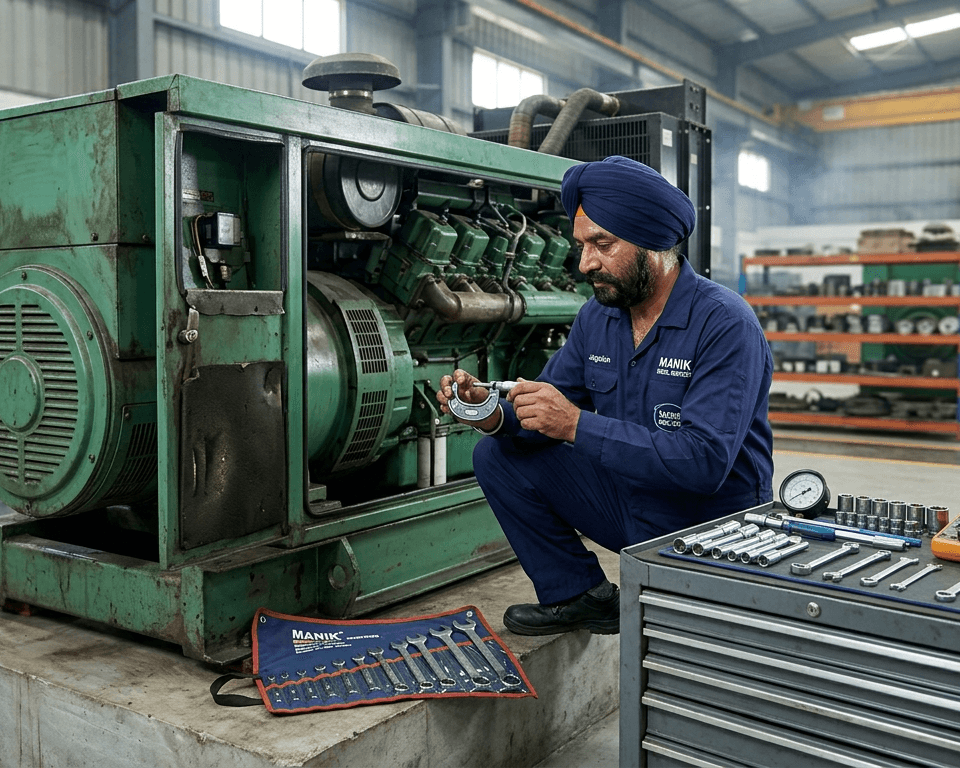
Why preventive maintenance fails without a structured checklist
Most industrial DG sets that fail at critical moments have a maintenance history. They were serviced — but not systematically. A technician changed the oil when it was due. Someone checked the battery last quarter. The coolant was topped up in January. Nobody confirmed all these things together, and nobody checked the earthing or ran a load test this year.
Preventive maintenance on a diesel generator is not a list of tasks you can distribute across visits. Each item interacts with others. Low coolant and a blocked radiator together cause an overtemperature trip that neither would cause alone. A weak battery combined with a partially blocked fuel filter extends cranking time and causes heat damage to the starter motor. Systematic PM means checking everything in sequence, not checking everything eventually.
This checklist follows the intervals we use for industrial AMC clients in South Gujarat — daily, weekly, monthly, quarterly, and annual. Each item includes what to check, what an acceptable result looks like, and what to do if it fails.
Daily checks — 10 minutes before first start
Fuel level: confirm the day tank is above 25% capacity. A generator that runs low on fuel draws air into the fuel system and requires bleeding before the next start. Maintain minimum 50% in the day tank for sites with unplanned outages.
Engine oil level: check the dipstick. Oil should be between the minimum and maximum marks. If it has dropped more than half a mark since the previous check at the same interval, investigate consumption before it becomes a downtime event.
Coolant level: check the header tank or overflow bottle when the engine is cold. Low coolant causes overtemperature protection to trip during the first load acceptance. Add coolant at the correct concentration — do not add plain water to a previously treated system.
Battery indicator: check the panel for battery charge status or measure terminal voltage at rest. Anything below 12.4 V (12 V system) requires investigation. Confirm the key switch is off and the panel is in standby mode — a panel left in RUN mode will draw the battery down.
Visual inspection of the set: a one-minute walk around looking for fuel or oil on the floor under the engine, coolant staining at hoses or the radiator, damage to wiring or hoses, obstruction of ventilation openings, and any alarm lights on the panel. Fresh wet marks under the set are always investigated the same day.
Weekly checks
Test run with no load: start the engine and run at no load for 10 minutes. Check that it starts on the first or second attempt, reaches operating temperature, runs without hunting (governor instability), and shuts down cleanly. Record the date, run time, and any observations. A set that has not been started for more than 7 days is exercised this way.
Panel fault log review: check the AMF panel for any fault codes or alarm events logged since the last review. Even a fault that cleared itself — low oil pressure for one second, overspeed spike — is worth investigating before the next scheduled service.
Fuel system visual: check the primary filter bowl for water accumulation. Spin the sedimenter bowl and check for cloudy fuel or a water layer at the base. On sites with fuel quality variability, this check is worth doing every startup.
Exhaust at startup: observe exhaust colour for the first 60 seconds of startup and through the first load application. A brief white puff on cold start is normal. Persistent black, blue, or white smoke warrants investigation before the next planned service.
Monthly checks
Full load test: run the generator under real or simulated rated load for at least 30 minutes. Record voltage, frequency, oil pressure, coolant temperature, and exhaust smoke at 10-minute intervals. A set that passes daily checks but fails under sustained load has a problem the daily checks cannot reveal.
AMF auto-start test: simulate a mains failure by isolating the main incomer with the panel in AUTO. Confirm the set starts within the programmed delay, transfers load successfully, and retransfers when mains is restored. This test is the only way to confirm auto-start reliability.
Air filter inspection: remove and inspect the air filter element. On construction or textile sites, inspect weekly instead. A filter element that is more than half-blocked by visual inspection under light should be replaced regardless of service interval calendar.
Battery load test: apply a load test to the battery and observe voltage drop under starting current. A battery that drops below 9.6 V on a 12 V system under load test is borderline. Below 9.0 V, replace it. Do not wait for a failed start to identify a weak battery.
Exhaust system check: inspect the exhaust flexible, silencer, and stack for leaks, cracks, and proper mounting. Exhaust leaks are both a carbon monoxide risk and an indication of thermal cycling damage to the system.
Quarterly checks (every 250 to 500 hours)
Engine oil and filter change: change engine oil and oil filter at the OEM-specified interval — typically 250 hours for industrial duty in South Gujarat ambient conditions, or 500 hours for sets running moderate industrial load with quality oil. Use oil of the correct grade and viscosity specified for the engine and ambient temperature range.
Fuel filter change: replace primary and secondary fuel filters at the same interval as oil, or when monthly inspection shows restriction. Running a diesel injection system with a blocked fuel filter damages the fuel injection pump.
Coolant inhibitor test: test the coolant for inhibitor concentration with test strips. Depleted inhibitors allow corrosion inside the cooling circuit. Top up with pre-mixed inhibitor at the concentration specified for your coolant system.
Belt tension check: check the alternator drive belt and cooling fan belt for correct tension and surface condition. A belt that is cracked on the underside or shows glazing should be replaced at this interval, not at the next major service.
Terminal block torque check: open the engine control wiring connectors and torque all terminal screws to specification. Vibration-loosened terminals at the oil pressure sender or speed pickup cause false protection shutdowns.
Six-monthly checks
Injector visual or pop test: at 1,000 to 1,500 hours, or when black smoke or power loss symptoms appear, send one or more suspect injectors for bench testing. A full set test at this interval is part of our comprehensive AMC programme. Injectors that are over-delivering fuel waste money on every hour of operation — the test cost is recovered in fuel savings.
Turbocharger oil feed pipe inspection: with the engine cold, disconnect the oil feed pipe at the turbo inlet and inspect for carbon deposits inside the pipe. A partially blocked feed is invisible from the outside but starves the bearing. A feed pipe with significant carbon buildup should be cleaned or replaced.
Earthing continuity test: measure resistance from the generator frame to earth electrode. For an industrial installation, this should be below 1 ohm. Values above 5 ohms indicate the earth electrode connection is corroded or the electrode itself has dried out.
Radiator and cooling circuit pressure test: pressure test the cooling circuit to the OEM specification to check for slow leaks at hoses, the radiator core, head gasket, and water pump seal. Catching a developing leak at the pressure test stage is less expensive than diagnosing coolant contamination of the oil after a head gasket failure.
Annual checks
Compression test: run a cylinder-by-cylinder compression test and record the results. Compare against OEM minimum values. Any cylinder more than 15% below the highest cylinder in the set warrants investigation. Any cylinder below OEM minimum warrants a top overhaul assessment.
Full AMF panel functional test: test every protection circuit: low oil pressure shutdown, high coolant temperature shutdown, overcrank protection, overspeed shutdown, underspeed detection, low fuel alarm, and battery charge alarm. Record test results. A protection circuit that is not confirmed annually may be silently failed.
Valve clearance check and adjustment: check and set valve clearances to the OEM cold-engine specification. Valve clearances drift over time with seat wear and thermal cycling. Incorrect clearances cause power loss, increased fuel consumption, and valve damage.
Alternator winding insulation test: use a megger to test insulation resistance from each phase winding to earth with the engine stopped and cool. Insulation resistance below 2 megohms indicates moisture contamination or winding deterioration. This is a leading indicator of an alternator fault before it causes a failure under load.
Full documentation review: at the annual visit, review the complete service history for the set. Identify any pending items, increasing trends in oil consumption or battery performance, and update the AMC scope if the set's duty profile has changed.
How AMC and self-maintenance compare in practice
The checklist above is what a structured AMC programme delivers. Self-maintenance can execute the same items if the site has a trained technician, the correct tools, and the discipline to follow the intervals without slipping. Most industrial plants without dedicated power technicians find that self-maintenance drifts — the daily checks happen, the quarterly and annual checks do not.
The economic case for AMC over self-maintenance is covered in detail at /blog/dg-set-amc-vs-pay-per-visit. The summary: a single missed service that leads to a bearing failure or a head gasket costs more than an annual AMC for most industrial DG sets.
If the site has a full AMC in place, this checklist is a reference for site personnel to verify that their AMC provider is covering the full scope. If visits are only addressing oil changes and filter replacements, the checklist above shows what is being missed.
Frequently asked questions
How often should a DG set be serviced if it rarely runs? Monthly exercise runs and quarterly system checks are still warranted even for sets on standby duty. Batteries sulfate, coolant inhibitors deplete, fuel degrades, and rubber components age on standby sets even without running hours accumulating.
Can site technicians do quarterly PM without specialist equipment? Yes for most items: oil change, fuel filter, belt check, visual inspection, and coolant test. Battery load testing requires a load tester — a small investment worth making if the site has one or more sets. Compression testing, injector testing, and insulation resistance testing require specialist equipment and are typically part of AMC visits.
How do I track PM compliance across multiple DG sets? A simple logbook per set recording each check date, findings, and action taken is the minimum. Sites with multiple sets benefit from a maintenance management spreadsheet that flags when quarterly and annual checks are coming due. We provide a digital service record for all AMC clients.
What is the correct oil grade for a diesel generator? This is engine-specific — check the engine nameplate or OEM manual. Most South Gujarat industrial engines use SAE 15W-40 or SAE 40 mineral oil in standard ambient conditions. High-specification engines may require SAE 10W-40 semi-synthetic. Never substitute an alternative grade without confirming against the OEM specification.
How do I know if my current AMC provider is following a proper checklist? Request the service report from each visit. A provider following a proper PM programme will produce a written report covering each item checked, the reading or observation, and the action taken. A report that only records oil change and filter replacement without compression, battery, electrical, and cooling checks does not represent a full AMC visit.
AMC that follows this checklist — Manik Diesel Services
Our AMC programme for industrial DG sets in South Gujarat follows the full checklist described in this post. Each scheduled visit produces a written service report. Quarterly and annual visits include compression testing, battery load testing, and full protection circuit verification.
We cover Sachin GIDC, Pandesara, Hazira, Udhna, Bardoli, Navsari, and surrounding industrial areas. For AMC enquiries, breakdown attendance, or to discuss what your current AMC programme is covering, contact us on +91 99980 20245 or WhatsApp at wa.me/919998020245. Service details at /services/dg-set-repair-amc.