Why Is My DG Set Not Starting? 9 Causes Diagnosed by Workshop Technicians
Battery, FIP, air lock, AMF panel, oil pressure — a workshop diagnosis sequence for DG sets that crank but won't fire or won't crank at all.
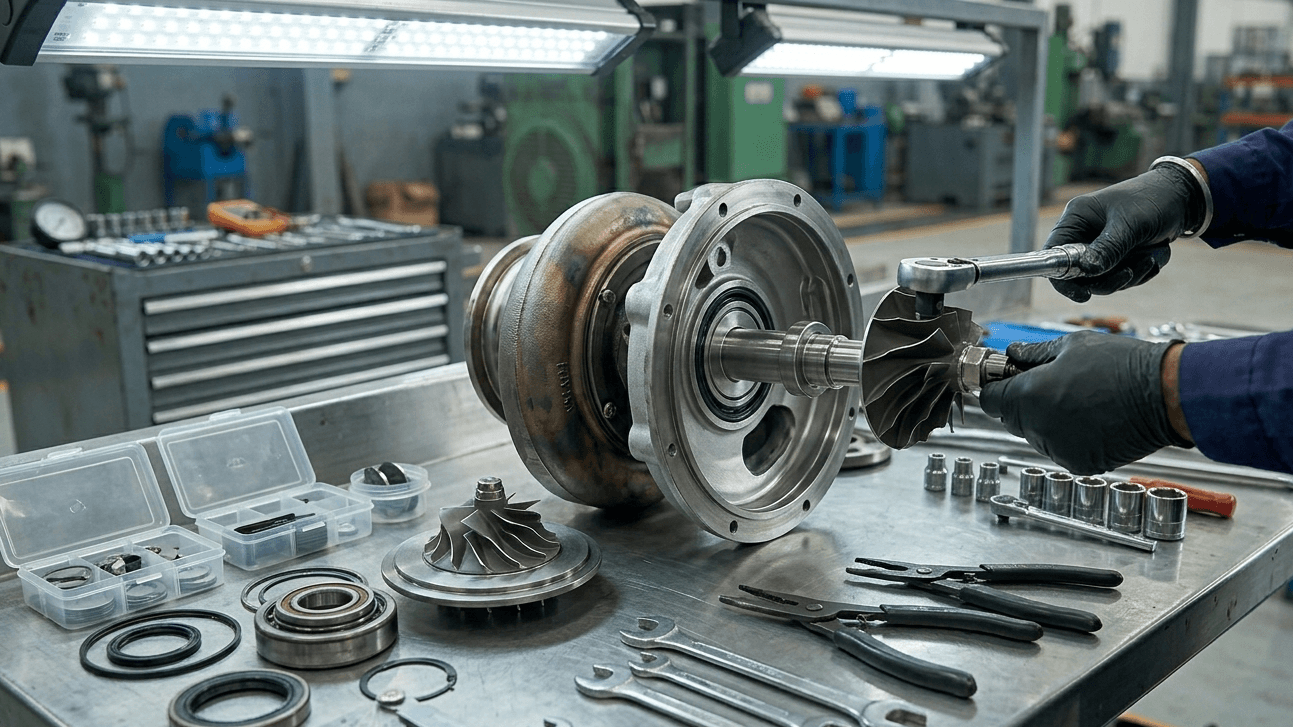
How to read a no-start fault before touching anything
A DG set that refuses to start is telling you something specific — if you know how to read the symptoms. The diagnosis sequence matters. Jump to the fuel injection pump before ruling out the battery and you will waste time and possibly make the fault worse.
This guide follows the order we use at the workshop: start with the simplest, most accessible cause and work toward the more involved ones. Each cause includes the symptom pattern, a quick field check you can do with basic tools, and a clear line between what you can fix on site and what needs specialist attention.
These nine causes cover the majority of no-start calls we attend. A few require only a charged battery or a bleed screw. Others — particularly FIP and seized components — require workshop diagnosis and calibrated equipment.
Cause 1: Flat or weak battery
Symptom: The starter motor turns slowly, makes a clicking sound, or does not engage at all. The control panel lights may be dim or absent.
Quick check: Measure terminal voltage with a multimeter. A healthy 12 V battery at rest reads 12.6 V or above; a 24 V system reads 25.2 V or above. Anything below 11.8 V (12 V) or 23.5 V (24 V) under load indicates a battery that cannot deliver starting current. Check the terminals for corrosion and the cable connections for looseness.
Fix or escalate: Clean the terminals, tighten the connections, and attempt a charge. If the battery holds charge and the set starts normally, schedule a load test and inspect the charging circuit. If the battery fails the load test, replace it. A DG set battery that is more than three years old and showing weakness should be replaced rather than nursed — failed starts stress every component in the starting circuit.
Cause 2: Fuel starvation
Symptom: The engine cranks at normal speed but does not fire, or fires briefly and dies. There may be no smoke from the exhaust at all during cranking.
Quick check: Check the fuel tank level — not just the gauge, open the tank or use a dipstick if the gauge is suspect. Check that the fuel cock or isolating valve is fully open. Inspect the fuel line from tank to primary filter for kinks, collapsed hose, or a closed manual shutoff that someone left closed after the last service.
Fix or escalate: Open valves, straighten or replace kinked lines, and fill the tank if needed. If the tank has water contamination — visible as cloudy fuel or a water layer at the base of the tank — drain and clean the tank before attempting further starts. Water in diesel is a common problem on sets that sit unused for extended periods.
Cause 3: Air in the fuel line
Symptom: The engine cranks, may fire for one or two seconds, then cuts out. This pattern often follows a fuel run-out, a filter change, or any work that opened the fuel system.
Quick check: Locate the bleed screws on the primary filter bowl and the secondary filter. Open them slightly while operating the hand primer pump (if fitted) until bubble-free fuel runs from each bleed point. On systems without a hand primer, use the electric lift pump by cycling the ignition key briefly. Watch for bubbles — continuous bubbling that does not clear after several bleed cycles suggests a suction-side air leak.
Fix or escalate: Bleed the system systematically from the tank forward: primary filter, secondary filter, and finally the injection pump inlet. If air returns after the set runs for a few minutes and shuts down again, inspect every fuel line joint, clamp, and union on the suction side. A cracked line or loose fitting is the usual culprit. Persistent air entry into the high-pressure side of the system requires workshop inspection.
Cause 4: Faulty fuel injection pump
Symptom: The engine cranks strongly, the fuel system is full and bled correctly, but there is still no injection — no smoke, no attempt to fire. Alternatively, the set starts hard and runs roughly before dying.
Quick check: Crack open a high-pressure injector line at the injector while cranking. If fuel pulses out, the pump is delivering. If there is no flow or flow is very weak, the pump is the suspect. Also check that the fuel rack is not stuck — on mechanical pumps you can sometimes feel the rack position by hand when the engine is stationary.
Fix or escalate: A failed FIP is not a field repair item. Injection pump calibration requires a dedicated test bench to verify delivery volume, timing, and pressure across the RPM range. Attempting to adjust the pump on the engine without test equipment will produce inconsistent delivery that either damages the engine or causes persistent starting and running problems. Bring the pump to a workshop with test bench capability. Our /services/fuel-injection-pump-repair service covers testing, calibration, element replacement, and governor overhaul for all major pump types.
Cause 5: Clogged fuel filter
Symptom: The set may start when cold but dies under load, or cranks and fires weakly. In severe cases, fuel starvation prevents starting entirely. The symptom often develops gradually over weeks.
Quick check: Check the service interval record. If the fuel filter has not been changed within the recommended hours, treat it as suspect. On sets with a vacuum gauge on the suction side of the pump, a reading above the normal range confirms restriction. On sets without a gauge, a quick method is to temporarily bypass the secondary filter with a clean test element — if the set starts normally, the original element is blocked.
Fix or escalate: Replace both the primary and secondary filter elements as a pair. Using mismatched or substandard elements is a false economy on diesel injection systems. After replacement, bleed the system as described in Cause 3. If the filters were heavily contaminated, inspect the tank for sludge buildup and consider a fuel tank clean.
Cause 6: High coolant temperature protection triggering
Symptom: The set starts normally, runs for a short period, then shuts down. The shutdown may repeat consistently. The temperature gauge or warning lamp may show high temperature, or the panel may log a high-temp fault.
Quick check: Check the coolant level in the overflow bottle and radiator when the engine is cold. A low coolant level is the first thing to look for. Then inspect the radiator fins for dust and debris blockage — on industrial sites this is extremely common. Check that the cooling fan is spinning freely and that the fan belt is not slipping or broken.
Fix or escalate: Top up coolant with the correct mix of water and corrosion inhibitor. Clean the radiator fins with compressed air. If the level was low, inspect hoses, the radiator, the water pump, and the head gasket area for leaks before returning the set to service. A set that trips on high temperature repeatedly without an obvious external cause may have a failing thermostat, a weak water pump impeller, or early signs of a head gasket problem — all of which require workshop inspection.
Cause 7: AMF panel fault or wiring issue
Symptom: On auto-start sets, the mains fail but the DG set does not start. Or the set starts but does not accept load. Or the panel shows a fault code without the engine attempting to crank. Manual start may work fine.
Quick check: Check the AMF panel for fault codes or alarm indicators. Verify that the panel is in AUTO mode, not MANUAL or OFF. Check that the control fuses and MCBs inside the panel are healthy. On older panels, check for loose wiring at the control terminal strip — vibration over time can loosen connections that cause intermittent start failures.
Fix or escalate: AMF panel faults range from a blown control fuse — a two-minute fix — to a failed control board or contactor, which requires component-level diagnosis and replacement. If the panel shows a specific fault code, note it before calling for service. If you find loose wiring, reseat the connections and check that no bare conductors are shorting to chassis. Panel board replacement and contactor servicing are covered under our /services/dg-set-repair-amc programme.
Cause 8: Oil pressure lockout
Symptom: The engine cranks, may attempt to start, but shuts down within two to five seconds. The oil pressure warning lamp stays on or a low-oil-pressure fault is logged on the panel.
Quick check: Check the engine oil level on the dipstick. If the level is low, top up with the correct grade and attempt a restart. If the level is correct, the issue may be a faulty oil pressure sensor sending a false low-pressure signal, or actual low oil pressure from a worn oil pump or blocked oil pickup strainer.
Fix or escalate: Do not disable the oil pressure shutdown to force the engine to run — this protection exists to prevent catastrophic bearing damage. If topping up oil resolves the shutdown, investigate why the level dropped: a leak, consumption, or dilution. If the oil level is correct and the fault persists, check the sensor signal with a gauge at the oil gallery before concluding the pump or engine internals are the cause. Persistent low oil pressure with normal oil level is a workshop diagnosis.
Cause 9: Seized components
Symptom: The starter motor activates but the engine does not rotate, or rotates only a small amount and stops with a heavy load on the starter. The starter may trip on overcurrent. In extreme cases, the starter pinion can be heard engaging and slipping without turning the flywheel.
Quick check: With the ignition off, try to rotate the engine manually using a bar on the crankshaft pulley or flywheel. An engine in good condition should turn with moderate effort. If it will not turn, or turns only with very high force, internal seizure is confirmed. This can be a seized piston or liner, hydrostatic lock from coolant or fuel entering a cylinder, or a seized ancillary drive component such as an alternator or compressor bearing.
Fix or escalate: Do not crank a seized engine with the starter motor — it will damage the ring gear and starter. If you suspect hydrostatic lock, remove all injectors or glow plugs before attempting manual rotation to release any liquid in the cylinders. True mechanical seizure requires workshop strip-down. An engine seized from running low on oil or running at high temperature without coolant will typically need bore measurement, bearing inspection, and assessment of whether the block is serviceable or needs replacement.
Frequently asked questions
Why does my DG set crank but not start even after I filled the fuel tank? Fuel reaching the tank is not the same as fuel reaching the injection pump. Check whether the fuel cock is open, the primary filter is not blocked, and the system has been properly bled of air — especially if the tank ran dry before you refilled it. Air lock is the most common reason a DG set refuses to start after a fuel runout.
Can I start my DG set by bypassing the oil pressure switch? Technically you can wire around the shutdown, but doing so removes the protection that prevents the engine from destroying its bearings if oil pressure is genuinely absent. Always diagnose the root cause first. A faulty sensor is a common and inexpensive fix; running without oil pressure protection is not worth the risk.
How often should DG set batteries be replaced? Most DG set batteries in continuous service are replaced every two to three years depending on ambient temperature, charge cycle frequency, and whether the set sits on standby for long periods. A battery on a set that rarely starts will sulfate faster than one on a set with regular test runs. Load test the battery annually once it is past two years old.
My AMF panel shows a fault code but I cannot find what it means. Note the exact code and the panel manufacturer and model number when you call for service. Most AMF panel fault codes are documented in the panel manual. Common codes relate to low oil pressure, high coolant temperature, overcrank (too many start attempts without firing), underspeed, or overspeed. Each fault has a specific resolution path.
The DG set starts fine manually but fails on auto start. What should I check? The most common causes are the panel being left in MANUAL mode, a fault in the mains sensing circuit that is not correctly detecting a mains failure, or a control wiring issue between the panel and the engine start solenoid. Also check whether a recent service reset the panel settings — some panels revert to factory mode after a power loss.
When to call Manik Diesel Services
Battery, fuel level, bleed screws, filter replacement, and AMF panel fuse checks are all reasonable first steps for a site technician. Everything beyond that — injection pump calibration, oil pressure diagnosis, seized engine strip-down, AMF panel board replacement — requires workshop equipment and trained hands.
We have been diagnosing and repairing DG sets from our Sachin GIDC workshop since 1981. Our team handles fuel injection pump testing and calibration on a dedicated test bench, full DG set overhauls, AMC contracts, and breakdown attendance across South Gujarat.
For fuel injection pump faults, see our /services/fuel-injection-pump-repair page. For full DG set servicing, AMC contracts, and breakdown support, visit /services/dg-set-repair-amc.
Call or WhatsApp us on +91 99980 20245 to describe the fault. We will tell you whether it is something you can resolve on site or whether the set needs to come in.