AMC vs Pay-Per-Visit for DG Sets: Which Saves More for Gujarat Industries?
A cost-by-cost breakdown of AMC vs breakdown maintenance for industrial DG sets — with real downtime numbers for textile and chemical plant managers.
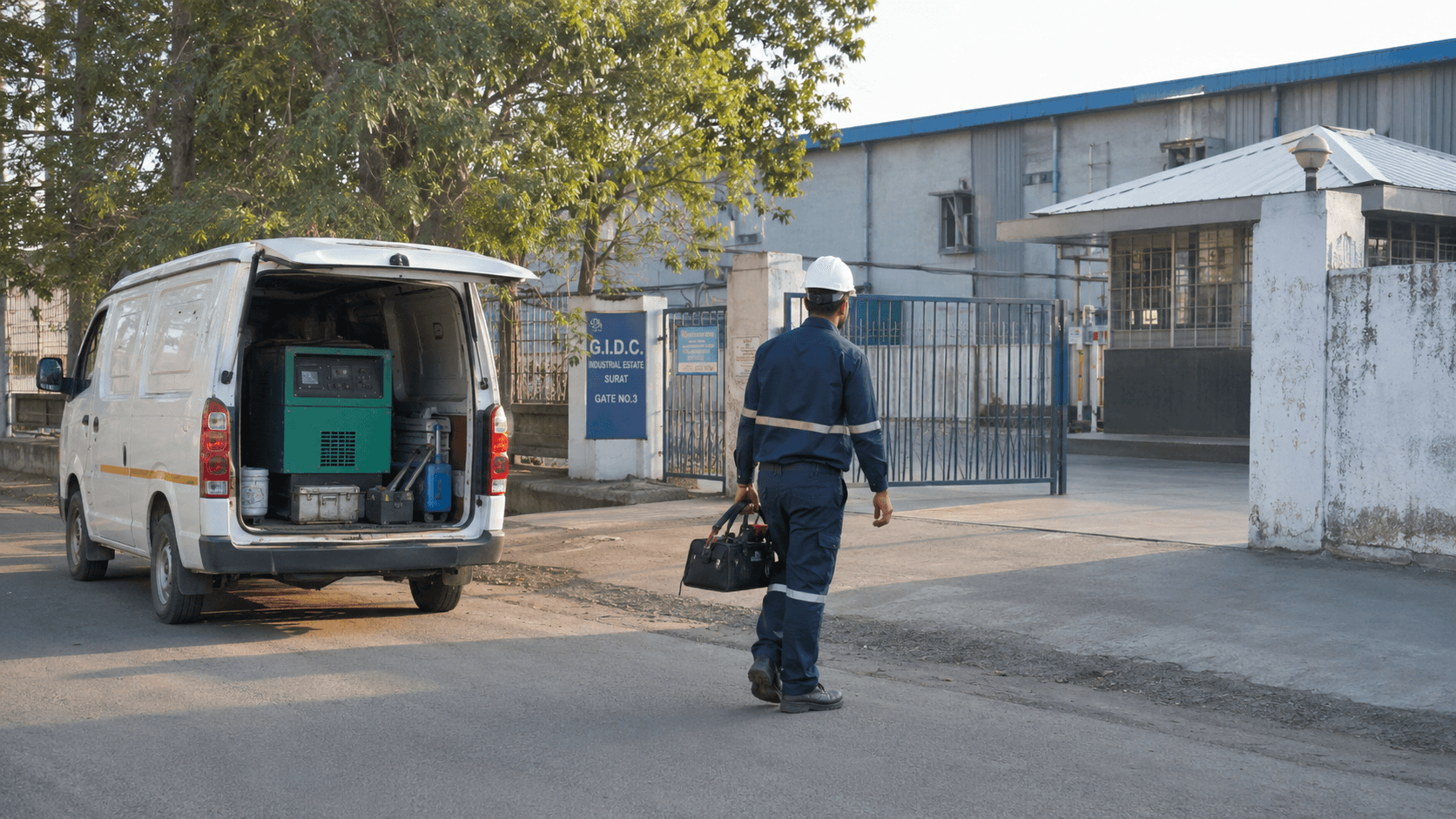
The question every plant manager faces
You have a 250 kVA Kirloskar or Cummins DG set powering your production line. It starts reliably most days, so you skip a formal maintenance contract and call a technician only when something goes wrong. The logic seems sound — why pay for scheduled visits when the set is running fine?
This article runs through the actual numbers behind both approaches: Annual Maintenance Contract (AMC) and pay-per-visit breakdown maintenance. The difference matters more for high-runtime industrial sites in Gujarat than anywhere else, because here the DG set is not just backup — it is often the primary power source during frequent grid fluctuations.
What an AMC actually covers
A standard AMC for a 125–500 kVA DG set in the Surat–Sachin GIDC belt typically includes four to six scheduled visits per year. Each visit covers engine oil and filter change, fuel filter replacement, air filter cleaning or replacement, coolant level and quality check, battery terminal inspection and load test, belt tension check, alternator winding inspection, control panel parameter check, and a load test run.
Some contracts include parts at cost; others include parts up to a fixed value. The critical word is scheduled — a technician visits before a problem appears, not after production has stopped.
For a 250 kVA set, a full-coverage AMC in the Surat industrial market currently runs between Rs 28,000 and Rs 48,000 per year depending on engine make, inclusion of consumables, and travel zone. For a 500 kVA set, expect Rs 55,000 to Rs 90,000.
What actually drives breakdown maintenance costs higher
A breakdown callout has three cost layers that most plant managers do not add up until the invoice arrives. First, the service call itself: a technician visit for diagnosis and repair on an unscheduled basis costs Rs 2,500 to Rs 6,000 for the visit alone, before any parts.
Second, parts availability. When a turbocharger shaft seal fails at 2 PM on a Wednesday, the part may not be in stock locally. Sourcing from Mumbai or Ahmedabad adds Rs 800 to Rs 2,500 in courier cost and one to two days of delay. For some injector components or AVR modules on older sets, the lead time stretches to four to seven days. Every day the DG set is down, your grid dependency is exposed.
Third, and most expensive: production downtime. A textile dyeing unit running three shifts loses Rs 1.2 to Rs 2.8 lakh per unplanned production day depending on batch size, order commitments, and energy costs of restarting stopped equipment. A chemical process plant with continuous batch reactors can lose even more — between Rs 2.5 and Rs 5 lakh per day — when a forced shutdown affects in-progress batches that cannot simply be paused.
Add a single major unplanned breakdown per year — injector set replacement, head gasket, or AVR failure — and the parts and repair bill alone reaches Rs 18,000 to Rs 55,000 before production loss is counted.
Side-by-side cost comparison over 12 months
Consider a 250 kVA DG set running 8 to 10 hours per day at a textile processing unit in Sachin GIDC. Under pay-per-visit, you might spend Rs 4,500 for two routine visits you call for, Rs 3,200 for a fuel filter and belt change, and then face a single injector failure mid-year: diagnosis visit Rs 3,500, injector set Rs 22,000, courier sourcing delay two days. Total direct cost: approximately Rs 33,200. Production loss from the two-day delay: Rs 2.4 lakh minimum. Actual cost of pay-per-visit that year: over Rs 2.7 lakh.
Under AMC with the same set, you spend Rs 38,000 for the annual contract covering six visits, oil, filters, and belts. Injector wear detected at the fourth scheduled visit triggers a planned replacement: parts Rs 22,000 at scheduled price, zero downtime because the replacement is done during a planned maintenance window. Total cost: Rs 60,000. No production loss.
The gap is not Rs 5,000. The gap is over Rs 2.1 lakh once you account for what a 48-hour breakdown actually costs your plant.
For a lower-runtime installation — say a 62.5 kVA set at a logistics warehouse that only runs 3 to 4 hours per week during grid outages — the math reverses. Total annual runtime is under 200 hours. Parts wear is minimal. An AMC at Rs 16,000 may cost more than the Rs 6,000 to Rs 9,000 in actual scheduled maintenance that machine needs. Here, pay-per-visit makes financial sense because the production-loss risk from downtime is low.
The hidden cost: deferred maintenance compounds
Pay-per-visit maintenance has a structural problem that the annual numbers understate. When there is no scheduled visit, small issues accumulate. A partially clogged air filter raises fuel consumption by 4 to 8 percent and raises cylinder temperatures. A weak battery that fails a load test will cause a no-start the next time grid power cuts at 11 PM on a Friday. Belt wear that would cost Rs 400 to replace at a scheduled visit costs Rs 400 plus an emergency call fee plus potentially a seized alternator if it snaps under load.
We see this pattern regularly at Manik Diesel Services: generators brought in after breakdown that have three or four maintenance issues that were developing simultaneously. Each one individually would have been a minor scheduled item. Together, they turn into an overhaul.
An AMC forces inspection frequency. That inspection frequency is not a formality — it is the mechanism that keeps minor items minor.
Who should choose AMC and who should choose pay-per-visit
Choose an AMC if your DG set runs more than 500 hours per year, meaning roughly two or more hours per working day. This applies to most textile units, dyeing and printing plants, chemical process operations, food processing lines, cold storage facilities, and any site where a DG set outage directly halts production or damages in-process materials.
Choose an AMC if your DG set is above 125 kVA. Larger machines have higher repair costs, more interdependent systems, and longer parts lead times. The insurance value of scheduled maintenance is greater.
Choose an AMC if your nearest spare parts supplier is more than one day away from common items. In Sachin GIDC and Surat GIDC, most common parts are available within the day, but specialty items for older Perkins, Volvo, or MTU sets can take three to five days.
Choose pay-per-visit if your set is below 62.5 kVA, runs less than 200 hours per year, and your operation can tolerate a 24 to 48-hour gap in backup power. Small commercial offices, warehouses with minimal cold-chain exposure, and residential backup installations often fall here.
If you are unsure, calculate your actual runtime hours over the last six months and multiply the shutdown cost per day by a realistic breakdown probability. Even one medium repair every two years often tips the math toward AMC for industrial-grade sets.
What a good AMC contract should specify
Before signing, confirm the contract specifies the number of visits per year and what each visit includes by item — not a vague reference to routine maintenance. Confirm whether parts are included or supplied at cost, and whether the contract covers consumables like oil and filters or only labor.
Response time for breakdown calls within the AMC period matters. An AMC that guarantees a response within four working hours during Mon to Sat 9 AM to 7 PM is more valuable than one that is silent on response time. Ask specifically what the procedure is if a breakdown occurs outside business hours.
Confirm that the servicing technicians are trained on your specific engine make. A Cummins-trained technician and a Greaves-trained technician are not interchangeable for injector calibration or governor settings.
Our DG set repair and AMC service, listed at /services/dg-set-repair-amc, covers these points explicitly so clients know what each scheduled visit includes before the contract is signed.
Frequently asked questions
Does an AMC cover major repairs like engine overhaul or alternator rewind? Most standard AMCs cover scheduled maintenance and minor parts up to a defined value. Major repairs such as engine overhauling, alternator rewind, or turbocharger replacement are typically quoted separately. Some contracts include a labor discount for major repairs — confirm this before signing.
Can I switch from pay-per-visit to AMC mid-year? Yes. A technician should do a baseline inspection first so both parties agree on the current condition of the set. Entering an AMC on a machine with undisclosed wear is not in your interest or ours.
My DG set is 15 years old. Is an AMC still worth it? Older sets often benefit more from scheduled maintenance because wear rates are higher and parts lead times are longer. The baseline inspection becomes more important. We will tell you honestly if a set is better suited to a targeted repair plan than a standard AMC.
What happens if a part fails between scheduled visits under an AMC? A breakdown call is covered under the AMC labor terms in most contracts. Parts sourcing priority is usually better for AMC clients because the service history is known, and the diagnosis step is shorter.
How do I know if the scheduled visits are being done properly? Ask for a service report after each visit with the actual readings: oil pressure, coolant temperature, load test voltage and frequency, battery voltage under load, and any items flagged for next visit. A technician who cannot provide this is not doing the inspection — they are filling time.