Cummins vs Kirloskar DG Set: Which Is Better for South Gujarat Factories?
Cummins vs Kirloskar DG set India: spare parts access in Sachin GIDC, TCO for textile and chemical loads, and an honest trade-off framework.
Why this comparison matters for Sachin GIDC and Pandesara units
Most online comparisons of Cummins and Kirloskar stop at brochure specs. They list rated kVA, noise levels, and warranty periods, then leave the plant manager to figure out the rest. That approach misses the factors that actually decide five-year cost: what breaks, how quickly you get the part, and how the engine handles the load profile your process runs.
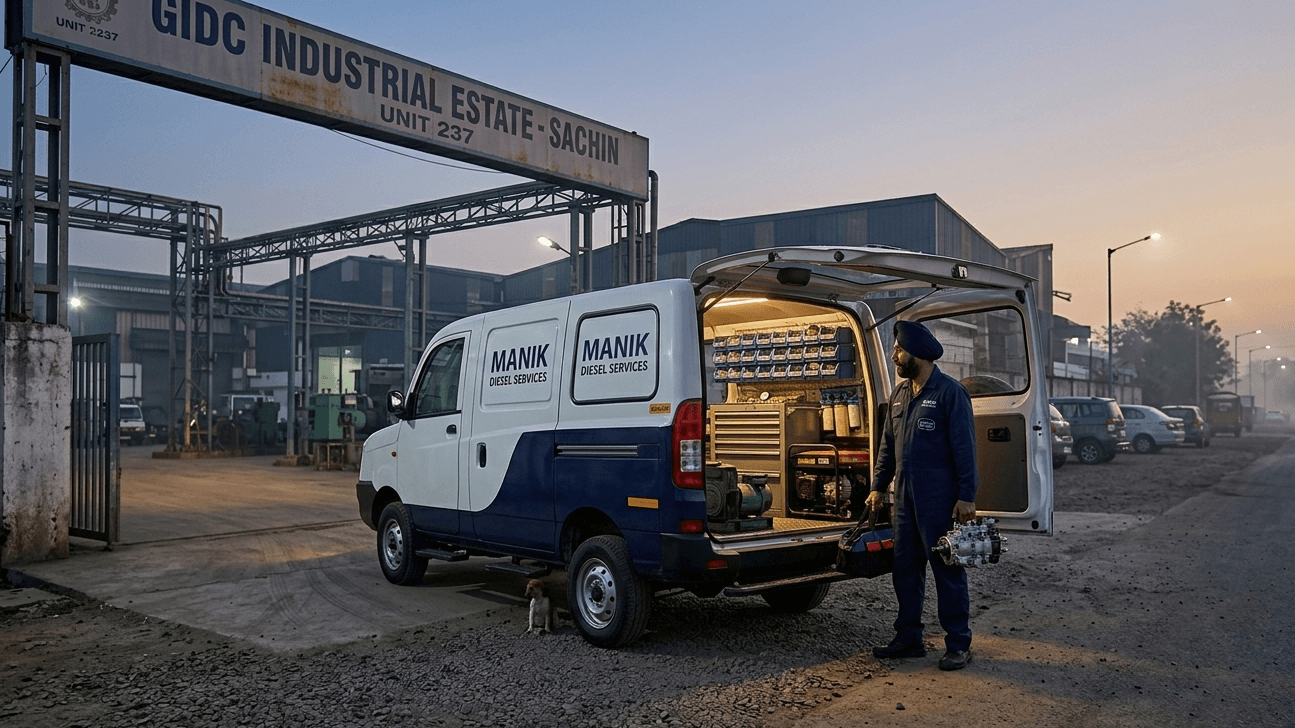
At Manik Diesel Services in Sachin GIDC, we service both brands across textile units in Pandesara, chemical process plants in Sachin, and logistics compounds along the Surat-Hazira corridor. The pattern we see is consistent: choice of brand matters far less than how well the set is matched to the load and how disciplined the AMC is. That said, there are real differences between Cummins and Kirloskar that affect running cost, and this guide covers them without declaring a winner.
The kVA ranges most relevant to South Gujarat factories are 125 to 500 kVA for textile and garment units, 250 to 750 kVA for chemical and dyeing plants, and 500 kVA and above for large process units or captive power applications. We will reference these ranges throughout.
Initial cost and procurement
Kirloskar DG sets generally carry a lower ex-showroom price than equivalent Cummins sets at the same kVA rating. At the 125 to 250 kVA range, the difference is typically 8 to 15 percent, depending on the panel and canopy specification. At 500 kVA and above, the gap narrows because both brands offer similar prime-rated pricing when purchased through dealers with installation included.
Cummins pricing reflects imported engine technology, global supply-chain components, and a dealer network with fixed service pricing. Kirloskar pricing reflects a domestically manufactured powertrain with localized sourcing. Neither is overpriced relative to what it delivers, but if capital cost is the binding constraint and your load profile is moderate, Kirloskar wins the initial purchase decision on numbers alone.
One procurement detail that matters locally: Kirloskar has a dealer in Surat with service-trained staff. Cummins dealers are present in Surat, but the nearest large Cummins power service centre is in Ahmedabad. For emergency spares procurement, that distance affects lead time when local stock is out.
Spare parts availability in and around Sachin GIDC
Spare parts availability is where the real cost diverges over three to five years. Kirloskar parts — air filters, oil filters, fuel filters, belts, injectors, and governor components — are stocked by multiple dealers and independent parts shops in Surat and Sachin. For a 125 kVA KG1 or a 250 kVA HA series engine, you can usually source a common consumable same day within the Sachin GIDC area.
Cummins parts for the B series and C series engines that power most 125 to 500 kVA sets are available in Surat, but stock depth at local dealers is thinner for the C series at 300 kVA and above. Turbocharger cartridges, injector cups, and EGR-related components often need to be sourced from Ahmedabad or ordered with a two to four day lead. If your plant cannot afford a two-day wait, you need to maintain your own critical-spare inventory for Cummins-powered sets.
For both brands, keeping a running stock of the following eliminates most downtime risk: fuel filter element, oil filter, air filter, drive belts, coolant hose set, injector set, and a spare battery. The difference is that Kirloskar consumables carry lower cost per piece and are available through more local channels. A plant running three Cummins sets should budget for a deeper spares holding than a plant running three Kirloskar sets at comparable kVA.
Fuel efficiency and performance under heavy industrial load
Both Cummins and Kirloskar publish rated fuel consumption figures at 75 and 100 percent load. In real South Gujarat industrial conditions — high ambient temperature, dusty intake air, long daily run hours — field consumption will vary from published figures. From our service records, a well-maintained 250 kVA Cummins C250D5 running at 70 to 80 percent load in a textile plant typically shows 52 to 58 litres per hour. A comparable Kirloskar KG2-250WS at the same load shows 55 to 62 litres per hour.
The Cummins B and C series engines are electronically governed on newer builds, giving tighter load response and slightly better part-load efficiency. Kirloskar HA and KG series engines use mechanical governing on most mid-range units, which is simpler but less responsive to rapid load steps. In textile units with large motor starting sequences, the Cummins electronic governor handles the load transient more cleanly.
For chemical process plants running at near-constant load across 18 to 22 hours a day, the difference in part-load efficiency matters less. If your set runs at 80 to 95 percent load continuously, both engines behave similarly. Where Cummins earns its cost premium is in variable-load applications where 30 to 60 percent load swings are common.
At loads below 40 percent of rated capacity, both engines accumulate wet stacking risk. If your 500 kVA set regularly runs a 120 kVA load because the grid came back and only essential loads remain, neither brand helps you — the solution is load management, not brand selection.
Reliability at 18-plus hours per day
South Gujarat textile and chemical units during peak season, or during extended grid failure periods, often push DG sets to 18 to 22 hours daily. That is a prime or continuous duty profile, and it is where engine design decisions show up.
Cummins B series engines at 82 to 200 kVA are rated for standby duty at their top kVA figures but can be derated for prime duty operation. The C series at 200 to 400 kVA handles prime duty natively at the rated prime kVA. If you are comparing a Cummins 250 kVA set against a Kirloskar 250 kVA set for continuous-run use, verify which rating class the set is sold under — standby sets are not designed for 18-hour daily operation without derating.
Kirloskar HA series engines have a long track record in Indian industrial conditions for extended-hour operation. The HA394, HA694, and HB2-320 engines are used in prime power applications across South Gujarat. Their mechanical simplicity reduces failure modes in dusty, humid environments where electronic sensors degrade faster.
Common failure modes we encounter on Cummins sets at high run hours: injector sleeve erosion on B series, EGR cooler fouling on electronically controlled C series, and belt tensioner wear at 1,500 to 2,000 hours if service is delayed. On Kirloskar HA and KG series: liner wear at 8,000 to 10,000 hours on prime-duty sets, governor drift on mechanical units if calibration is not checked at each major service, and valve seat recession if cooling runs consistently above the upper limit.
Neither brand presents unmanageable failure rates when maintained correctly. The factory manager running 18-hour days should plan a service at every 250 hours for both — not the 500-hour interval that suits a standby generator running 50 hours a month.
Service turnaround and AMC support in South Gujarat
AMC coverage is not uniform across both brands in this region. Kirloskar's dealer network in Surat handles AMC contracts directly, and independent service workshops like ours service both brands with equal capability on the mechanical side. Cummins power AMC in Gujarat is structured through the Cummins Power Generation dealer network, and the contract terms, response commitments, and parts sourcing are tied to that dealer.
For factories in Sachin GIDC or Pandesara, a practical question is: if the set fails on a Saturday afternoon, who shows up? Dealer-backed Cummins AMC may route you through a call centre with a response commitment that does not always match your urgency. Independent workshops covering both brands can often turn around a service visit faster because they are not managing a large territory.
Our AMC programme at Manik Diesel Services covers both Cummins and Kirloskar sets. We handle the periodic service schedule, maintain a log of run hours and fault history, and keep critical consumables for your specific engine in stock. If you want to understand what a multi-brand AMC covers, visit our DG set repair and AMC service page at /services/dg-set-repair-amc.
One real advantage of Kirloskar AMC in Gujarat: Kirloskar runs training programmes for independent technicians, and service manual access for HA and KG series engines is more open than Cummins service documentation. This means independent service quality for Kirloskar is more consistent across technicians than for Cummins, where proprietary diagnostics on electronically governed models require dealer-level scan tools.
Resale value and total cost of ownership
Cummins DG sets hold resale value better in Gujarat's used generator market. A five-year-old 250 kVA Cummins with a verifiable service history commands 15 to 20 percent higher resale than an equivalent Kirloskar at the same age and condition. The perception of Cummins as a premium brand drives this in the used market, regardless of actual mechanical condition.
Total cost of ownership over five years at 4,000 annual run hours, for a 250 kVA set in a textile plant running at 70 percent average load, breaks down roughly as follows. Initial capital: Kirloskar is lower by approximately 10 to 12 percent. Annual service cost: comparable if maintained at the same interval, but Kirloskar consumables cost 8 to 15 percent less per service. Fuel cost over five years: Cummins advantage of roughly 3 to 5 percent if the load is variable; negligible if the load is constant. Unplanned repair cost: depends entirely on maintenance discipline, not brand. Resale recovery: Cummins recovers more.
When you run the five-year TCO with those inputs, the two brands land close to each other for most South Gujarat industrial loads. The Cummins premium on purchase is partially recovered at resale and partially offset by slightly better fuel economy on variable loads. For chemical and process units running continuous loads on tight margin, the lower consumables cost on Kirloskar tips the TCO in Kirloskar's favour. For textile units with variable daily demand that will eventually sell the set and upgrade, Cummins' resale value is a real asset.
Frequently asked questions
Which brand is easier to get serviced in Sachin GIDC? Both brands are serviceable by competent independent workshops in the Surat area. Kirloskar has slightly broader parts availability locally, but for routine AMC on standard kVA ranges, parts availability for either brand is not a limiting factor if your service provider stocks the common consumables. The question becomes more important above 400 kVA, where Cummins-specific turbocharger and injector components may need to be sourced from Ahmedabad.
Can I run a Cummins or Kirloskar set for 20 hours a day continuously? Yes, but only if the set is rated for prime or continuous duty at the load you are running. A set purchased and rated for standby duty will see premature wear at sustained high-hour operation. Both brands offer prime-rated variants — specify this at purchase and confirm the kVA rating you will actually run against, not the nameplate standby kVA.
Which brand handles the voltage dips and load spikes typical of textile machinery better? Cummins electronically governed sets respond to load transients faster than mechanically governed Kirloskar models. If you are starting large looms, compressors, or dyeing machines in sequence and the load steps are fast, a Cummins with electronic governing will hold frequency and voltage more tightly. Mechanically governed Kirloskar sets are adequate for gradual load buildups but will show a deeper frequency dip on sudden large motor starts.
Is the Cummins warranty worth paying extra for? The standard Cummins warranty covers manufacturing defects for 12 months or 1,000 hours, whichever comes first. Kirloskar offers similar warranty terms. In practice, warranty claims for South Gujarat industrial sites rarely recover the cost difference between brands — most failures occur outside the warranty window or are maintenance-related, which voids warranty coverage regardless of brand. Do not let warranty terms drive your decision more than parts availability and AMC quality.
What is the most common mistake factories make when choosing between the two? They compare standby kVA ratings side by side and choose the higher number. A Cummins 275 kVA standby set and a Kirloskar 250 kVA prime-rated set are not equivalent if your load runs 16 hours a day. Match the duty rating — standby, prime, or continuous — to your actual daily run hours first, then compare brands within that category. That single step prevents the most expensive mismatches we see when called in to diagnose sets that are technically running but chronically underperforming. To discuss your specific kVA requirement, load profile, and which set makes sense for your unit, send a WhatsApp message to +91 99980 20245 with your current engine make, running hours per day, and the fault or concern you want addressed. We will respond with a specific recommendation.