Classification of Diesel Generators — A Technical Buyer's Reference
How DG sets are classified by power rating, duty cycle, rotational speed, stroke type, cooling system, fuel injection, mounting, and emission norms — and what each classification means for industrial buyers.
Why classification matters at the procurement stage
Two generators with the same nameplate kVA rating can behave very differently in service. The classification underneath that rating — duty type, speed, cooling system, fuel system, mounting, and emission category — decides how the set performs under your actual operating profile, what spare parts it consumes, and how long it lasts.
This reference covers the seven main classifications used in Indian industrial DG procurement. Understanding each one helps procurement teams compare quotations on technically equivalent terms, and helps plant engineers select the right machine for their site rather than the cheapest one that meets the headline rating.
Classification 1: Power rating range
Generators are first classified by rated electrical output. The bands are loose, but useful for understanding the market segment a particular machine targets.
Portable and micro sets sit between 1 kVA and 25 kVA. These are typically single-phase or low-output three-phase machines for small commercial premises, retail shops, or domestic backup. Light industrial sets cover 25 kVA to 125 kVA — small workshops, restaurants, office buildings, and clinics.
Medium industrial covers 125 kVA to 500 kVA. This is the dominant band for textile units, dyeing houses, small chemical plants, and mid-sized manufacturing in South Gujarat. Most AMC and breakdown work in the GIDC industrial belts happens in this range.
Heavy industrial sets run from 500 kVA to 2,000 kVA. These power large factories, hospitals, hotels, and process plants. Above 2,000 kVA, generators are typically deployed in parallel sets for redundancy and load matching, or as utility-grade prime power for very large installations.
Classification 2: Duty type — ESP, PRP, COP
The ISO 8528-1 standard defines three duty ratings that determine how the same generator can be applied. The duty type appears on the OEM nameplate and is the basis of the warranty.
Emergency standby power (ESP) is rated for backup duty only — variable load up to 100% of rating, limited to 200 hours per year, no overload capability. ESP-rated sets are appropriate for sites with reliable grid power that occasionally need backup. Running an ESP set on extended duty voids the warranty.
Prime power (PRP) is rated for unlimited annual hours at variable load averaging 70% of rating, with 10% overload available for one hour in twelve. This is the correct rating for most industrial sites that lose grid power frequently. PRP-rated sets are the workhorse of the Indian industrial DG market.
Continuous power (COP) is rated for unlimited annual hours at constant load up to 100% of rating, no overload. COP is used where the generator is the only power source — remote sites, off-grid process plants, mining operations. The engine is internally derated to handle the constant duty without thermal stress.
Classification 3: Rotational speed
Generator speed is determined by the alternator pole count and the required output frequency. The formula: rpm = (120 × frequency) / number of poles.
In India, the grid frequency is 50 Hz. Most industrial DG sets use a four-pole alternator, which requires the engine to spin at 1,500 rpm. Smaller portable sets may use a two-pole alternator at 3,000 rpm, which keeps the alternator physically smaller but increases mechanical wear and noise.
Some specialised applications use six-pole or eight-pole alternators at 1,000 rpm or 750 rpm respectively. Lower speed reduces mechanical stress and extends engine life, but increases physical size and capital cost. Marine and continuous-duty industrial sets in larger ratings often use lower speed for this reason. For 60 Hz markets (parts of the Gulf, Americas), corresponding speeds are 1,800 rpm and 3,600 rpm.
Classification 4: Engine stroke cycle
Diesel engines operate on either a four-stroke or two-stroke cycle. The classification has implications for fuel efficiency, maintenance, and emission profile.
Four-stroke engines complete one power stroke every two crankshaft revolutions, with separate strokes for intake, compression, power, and exhaust. The four-stroke cycle is the standard for all modern industrial DG sets in India. It offers better fuel efficiency, lower emissions, and cleaner combustion than two-stroke designs at typical generator speeds.
Two-stroke diesel engines complete a power stroke every revolution. They produce more power per unit displacement but consume more fuel and produce more emissions for the same output. Two-stroke diesels are now uncommon in stationary generator applications and are mainly found in legacy marine and large-bore industrial installations.
Classification 5: Cooling system
Engine cooling is one of the most important classifications because cooling system design directly affects installation requirements, ambient performance, and maintenance burden.
Air-cooled diesel generators use a fan-driven airflow over finned cylinder heads and blocks to dissipate combustion heat. The design is mechanically simpler — no radiator, water pump, coolant, hoses, or thermostat. Air-cooled sets are appropriate for portable and light commercial applications below 25 kVA, particularly where coolant maintenance would be inconvenient.
Water-cooled (liquid-cooled) diesel generators use a closed-loop coolant circuit with radiator, water pump, thermostat, and engine-driven fan. The coolant absorbs heat from the engine block and head, transfers it to the radiator, and rejects it to ambient air. Water-cooled designs handle higher heat loads, sustain longer running hours, and operate more quietly than air-cooled equivalents. All industrial DG sets above 50 kVA use water cooling.
Maintenance considerations for water-cooled systems include coolant quality, radiator fin cleanliness, hose condition, and thermostat function. Industrial sites with high dust — particularly textile and grinding operations — need more frequent radiator cleaning than the OEM service interval suggests. We cover cooling system service as part of our AMC programme at /services/dg-set-repair-amc.
Classification 6: Fuel injection system
The fuel injection system is a major technical classification with direct implications for emission compliance, fuel efficiency, and service approach.
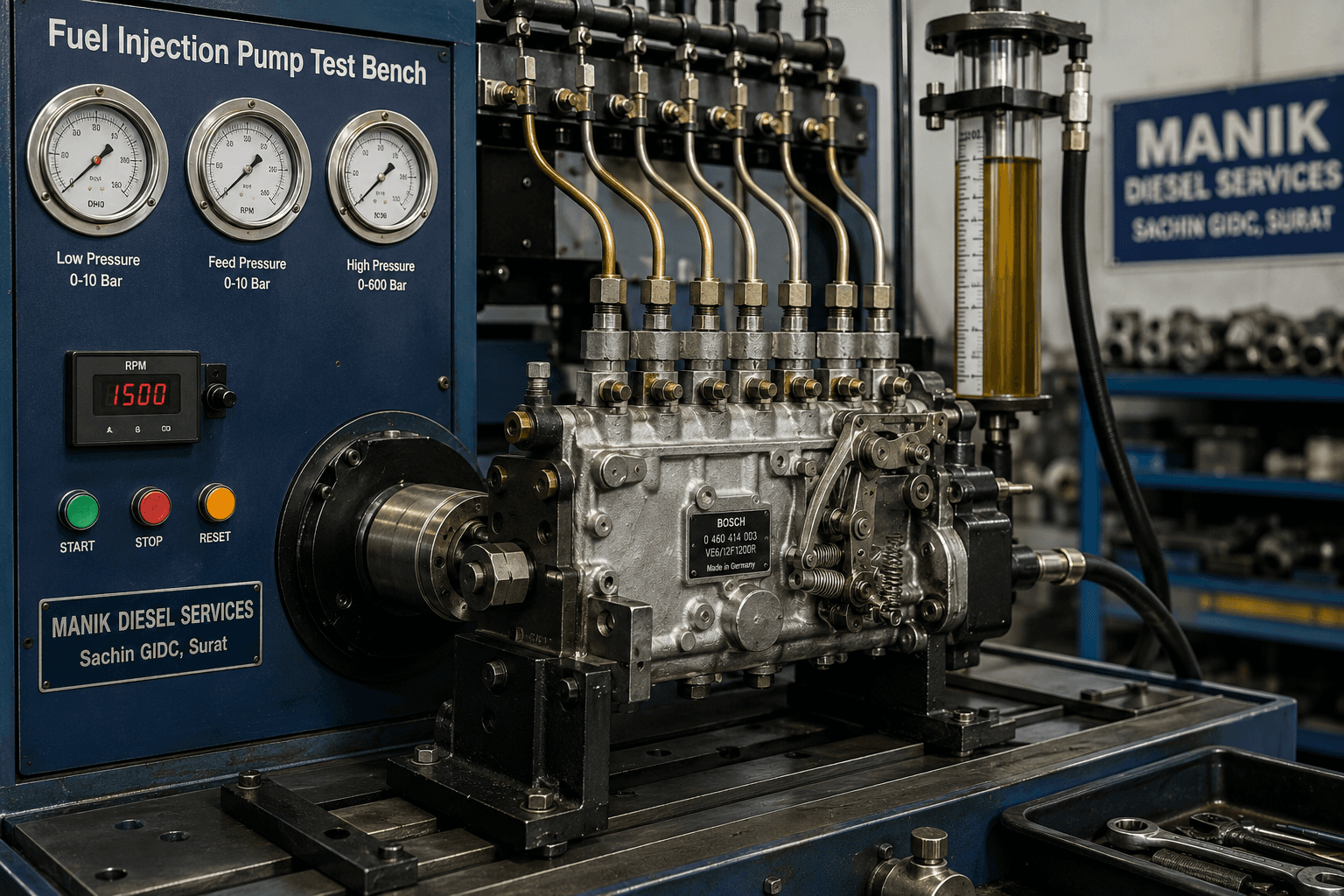
Mechanical injection covers traditional inline and rotary distributor fuel pumps with mechanical governors. The system is robust, tolerant of variable fuel quality, and serviceable with standard test bench equipment. Most older Cummins, Kirloskar, Mahindra Powerol, and Ashok Leyland engines use mechanical injection. Service is mature in the Indian aftermarket, and our /services/fuel-injection-pump-repair page covers the full service scope.
Electronic unit injection (EUI) and pump-line-nozzle (PLN) systems with electronic governing offer better fuel control, emission performance, and integration with engine management. These systems appeared on cleaner-emission industrial engines from the mid-2000s onward.
Common-rail direct injection (CRDI) is the dominant technology on modern CPCB-IV+ compliant industrial engines. Fuel is held at very high pressure (often 1,600 bar or above) in a common rail and metered electronically into each cylinder. CRDI delivers the cleanest emissions and finest fuel control, but requires more sensitive maintenance, cleaner fuel, and specialised test equipment.
Classification 7: Mounting and enclosure
How the generator is housed affects installation cost, noise compliance, and protection from the elements.
Open sets sit on a steel skid frame with engine, alternator, control panel, and basic ancillaries exposed. They are intended for installation inside a dedicated DG room with acoustic treatment and ventilation engineered into the building. Open sets are common in factories that build dedicated generator rooms.
Acoustic canopy (silent canopy) sets enclose the entire generator in a sound-attenuating steel housing with internal lining, intake and exhaust silencers, and weatherproofing. CPCB norms in India require 75 dB(A) at one metre for outdoor industrial installations — the silent canopy is what achieves this.
Containerised sets house the generator in a modified shipping container, typically used for very large industrial sets, mobile applications, or sites needing fast deployment. Container sets include integrated ventilation, fuel storage, control panels, and sometimes paralleling switchgear.
Trailer-mounted sets sit on a road-going chassis for rental, construction, and event power applications. Tow connections, wheels, and lighting bring this format into the broader vehicle category for road compliance.
Classification 8: Emission norm
The Central Pollution Control Board (CPCB) regulates emissions from diesel generators sold and operated in India. Generation of new emission norms has tightened steadily over the past two decades, and the norm category is a critical classification for both procurement and existing-fleet compliance.
CPCB-I, CPCB-II, and CPCB-III norms applied to generators manufactured in earlier periods. Sets built to these older norms remain in service across India but are subject to local SPCB rules and may need retrofitting or replacement depending on jurisdiction.
CPCB-IV+ is the current applicable norm for new DG sets in India for most ratings. The norm tightens limits on NOx, PM, CO, and HC, and requires emission-reduction technology — typically a combination of common-rail injection, exhaust aftertreatment, and improved combustion design.
When procuring a new generator for installation, always confirm the supplier is quoting CPCB-IV+ compliant equipment with valid type approval documentation. For existing sets below current norms, work with a CPCB-approved retrofit emission control device (RECD) supplier if your jurisdiction requires it.
Frequently asked questions
Can the same generator be sold as ESP, PRP, and COP? Yes — the OEM publishes different ratings for the same physical machine depending on duty class. A set sold as 250 kVA standby may be rated 230 kVA prime and 210 kVA continuous. Always confirm which rating is the basis of the quotation and warranty before signing.
What is the difference between 1,500 rpm and 3,000 rpm sets? At equal output, a 1,500 rpm generator has a physically larger alternator (more poles) but lower mechanical stress, longer engine life, lower noise, and lower fuel consumption per kWh. A 3,000 rpm generator is smaller and cheaper to buy but typically suited only to light or portable applications.
Are CRDI engines worth the extra service complexity? For sites required to meet current CPCB-IV+ norms, CRDI is effectively mandatory at most ratings. The service complexity is real but manageable with the right workshop and clean fuel handling practices. The fuel efficiency gain over older mechanical injection is significant on heavy-duty engines.
Can an air-cooled generator be used in a 24-hour industrial setting? Air-cooled designs are not suitable for sustained industrial duty above about 25 kVA. Heat rejection through fins becomes inadequate, cylinder head temperatures rise, and service life drops. Use water-cooled sets for any industrial application above light commercial scale.
How do I check the duty class of an existing generator on site? The duty class is published on the OEM nameplate riveted to the alternator end of the set. If the nameplate is missing or unreadable, contact the OEM with the serial number for a duty certificate. This is essential before scoping any retrofit or expansion of how the set is used.
Get advice on classification before you specify
Selecting the wrong duty class, cooling type, or emission category at procurement is expensive to correct after installation. At Manik Diesel Services we walk procurement and engineering teams through generator classification when they are scoping a new purchase or evaluating supplier quotes.
We have been servicing diesel engines from our Sachin GIDC workshop since 1981 and have direct experience across every major classification on the Indian industrial market. Contact us on +91 99980 20245 or WhatsApp at wa.me/919998020245 for procurement advisory, AMC, or breakdown service. Workshop hours are Monday to Saturday, 9 AM to 7 PM.